Parliament says 2.8% of 86,401 food samples exceeded pesticide limits — why an organic farming community in Noida matters
The Silent Poison We’re All Eating
Every day, millions of Indians sit down to meals made with love — rice from Punjab, vegetables from Haryana, milk from Uttar Pradesh.
It looks fresh. It smells real. It feels safe.
But beneath that freshness lies a truth we’ve ignored for far too long.In August 2025, Parliament revealed something chilling:
Out of 86,401 food samples tested nationwide between 2022 and 2025, 2.8% contained pesticide residues above permissible limits.
That’s over 2,400 unsafe food items that had already reached our plates.
Now, imagine this:
Even the “safe” 97% of samples still contained pesticide traces within legal limits — but “legal” doesn’t mean harmless.
Those microscopic doses build up in our bodies over time, layer by layer, meal by meal.So the real question isn’t “What are you eating?” —
It’s “What are you slowly becoming?”
The 86,401-Sample Study That Shook India
The report came from the Monitoring of Pesticide Residues at National Level (MPRNL), under the Department of Agriculture & Farmers Welfare (DA&FW).
Samples were collected from across India — fruits, vegetables, pulses, tea, milk, spices, meat, and eggs — tested in 35 NABL-accredited labs.
The findings?
- 2.8% of samples breached the Maximum Residue Limit (MRL).
- Widespread contamination — not one region or crop spared.
- Peri-urban regions like Delhi-NCR among the worst hit due to dense pollution and aggressive chemical use.
According to FSSAI, pesticide traces are now found in over 70% of food samples tested yearly.
This isn’t a minor concern — it’s a national crisis hiding in plain sight.
The Science of Slow Poisoning
Pesticides don’t vanish once sprayed. They cling to the soil, seep into groundwater, and embed themselves into fruits and vegetables.
The National Institute of Nutrition (NIN), Hyderabad found that the average Indian consumes 70–200 times more pesticide residue per day than WHO’s safety limit.
And according to WHO, these toxins bioaccumulate — stored in fat tissues for years, silently damaging organs, hormones, and even DNA.
Common health effects include:
- Fertility issues and reproductive disorders
- Liver and kidney dysfunction
- Neurological damage
- Cancer
- Compromised immunity
We aren’t just feeding our children vegetables — we’re feeding them chemicals dressed as nutrition.
Delhi-NCR: The Epicenter of Contaminated Food
Delhi-NCR’s food system runs on peri-urban farms in Ghaziabad, Greater Noida, and Meerut, where chemical dependency has become survival.
The Central Pollution Control Board (CPCB) reports:
- High nitrate concentration in NCR groundwater
- Soil contamination from fertilizers and heavy metals
- Chemical runoff from nearby industries
And here’s the dangerous synergy — when soil already has toxins, adding pesticides makes the crop a chemical sponge.
ICMR’s study revealed that 65% of pesticide residues in Indian produce are systemic — absorbed inside the plant, not just on the surface.
So no amount of washing or peeling can save you.
(ICMR Food Safety Report)
The Health Fallout of Everyday Eating
A 2024 study published in The Lancet Planetary Health found that long-term pesticide exposure increases:
- Hormone-related cancers by 37%
- Fertility issues by 28%
- Neurodevelopmental disorders in children by 25%
Even if we can’t see the damage, our bodies remember.
And the worst part?
We’ve normalized it.
From Food Factory to Food Forest: The Organic Revolution
Organic farming isn’t a luxury trend — it’s a survival necessity.
It’s about replacing poison with patience, chemicals with care, and quantity with quality.
Organic systems avoid synthetic fertilizers and pesticides entirely. Instead, they nurture the soil using:
- Natural compost & cow dung
- Neem-based pest repellents
- Crop rotation & green manure
- Pollinator-friendly ecosystems
The National Centre for Organic & Natural Farming (NCONF) confirms that organic methods improve soil carbon by up to 30% and reduce chemical residue by over 90%.
When the soil heals, the food heals — and so do we.
The Global Shift: A Return to Clean Earth
Around the world, nations are waking up:
- EU targets 25% organic farmland by 2030.
- USDA reported organic sales surpassing $70 billion in 2024.
- Sikkim, India became the world’s first 100% organic state in 2016.
(Down To Earth)
Yet, in Delhi-NCR — one of the world’s fastest-growing metros — clean, traceable food remains a dream for most.
That’s where Sportsland Activity Farms enters the picture.
Sportsland Activity Farms: Where the Earth Feeds You Back
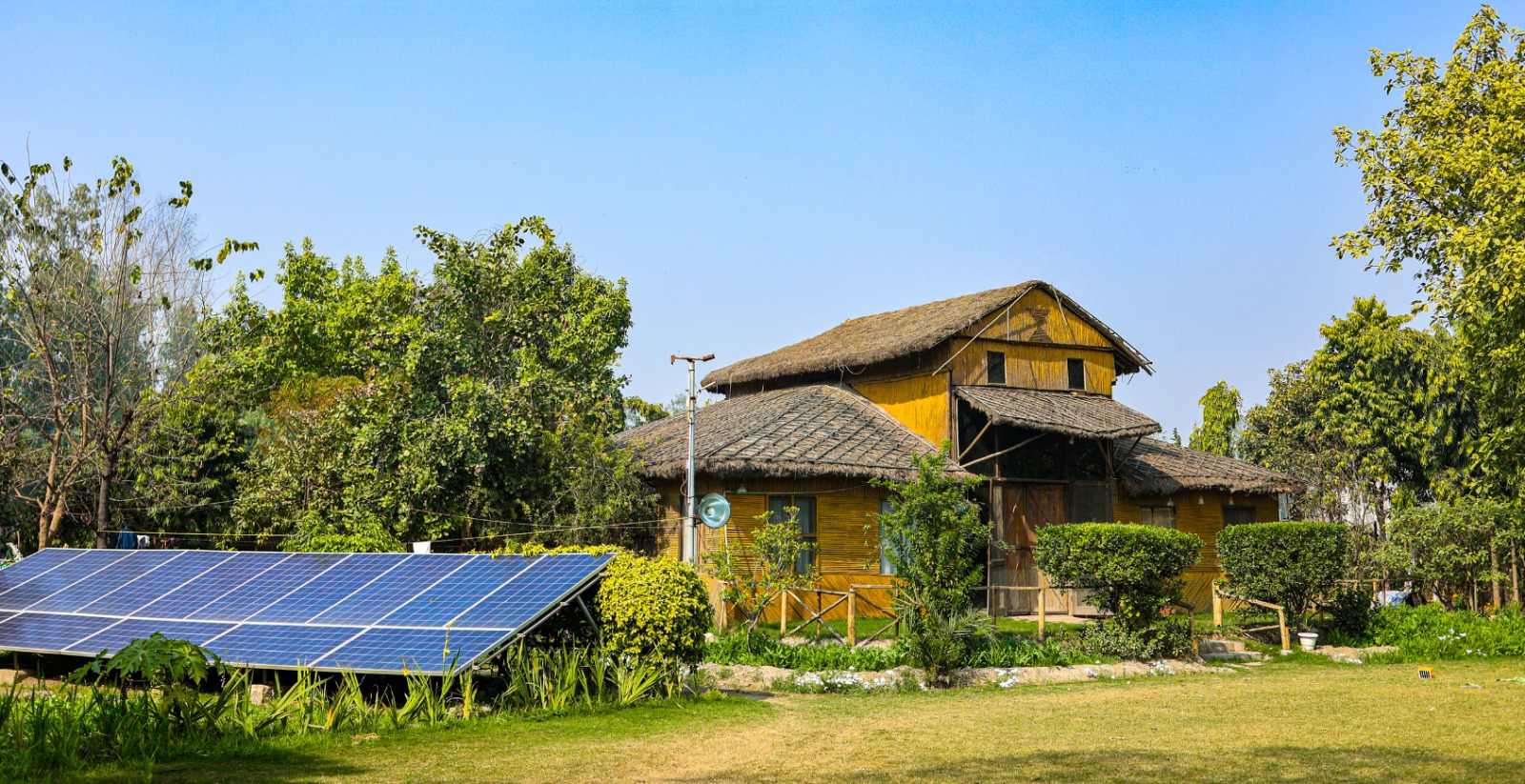
Welcome to Sportsland, an organic farming community in Noida that believes food security begins with soil security.
Spread across acres of green farmland, Sportsland combines modern living with traditional wisdom.
Here, every resident:
- Has a private organic backyard
- Consumes organic milk from the community’s own cattle
- Practices composting and water harvesting
- Breathes 99% pure air — far from urban smog
It’s not just sustainable — it’s soulful living.
Children learn to plant seeds instead of scrolling screens.
Adults reconnect with the land that once fed their ancestors.
And families eat pesticide-free food they’ve grown with their own hands.
That’s not just organic living — it’s organic belonging.
Inside Sportsland’s Ecosystem
Core Value | Practice | Outcome |
Self-Sustained Food | Private backyard farms | 100% traceable and pesticide-free food |
Water Stewardship | Rainwater harvesting, drip irrigation | 40% reduction in groundwater dependence |
Animal Welfare | Free-range cattle & natural feed | Organic dairy and ethical farming |
Zero Waste Living | Composting & biogas units | Closed-loop ecosystem |
Community Wellness | Farm markets, yoga spaces | Healthier, happier lifestyle |
Sportsland isn’t just a residential zone — it’s a living classroom for a new India built on conscious choices and green growth.
The Economics of Clean Food
Category | Chemical Lifestyle | Sportsland Organic Lifestyle |
Annual Veg Costs | ₹70,000–₹90,000 | ₹15,000 (seeds + soil inputs) |
Health Expenses | ₹40,000 avg | ↓ by 50% in 2 years |
Air/Water Filtration | ₹15,000 | Negligible |
Waste Disposal | ₹5,000 | ₹0 (recycled compost) |
ROI (Return on Integrity) | Low | Priceless |
Clean food doesn’t cost more — dirty food costs your health.
India’s Policy Push: The Green Mandate
The Indian government has rolled out several initiatives to support organic agriculture:
- Paramparagat Krishi Vikas Yojana (PKVY)
- Mission Organic Value Chain Development (MOVCDNER)
- Bhartiya Prakritik Krishi Paddhati (BPKP)
But while these policies sow seeds, it’s communities like Sportsland Activity Farms that harvest the results — making policy personal and practical.
The Emotional Side of Organic Living
When you grow your food, you regain control.
When your child waters a sapling, they learn empathy.
When your community thrives on clean soil, the air feels different — lighter, calmer, purer.
Sportsland Activity Farms isn’t selling homes; it’s offering heritage.
It’s a chance to live what your grandparents lived — clean food, fresh air, and land that loves you back.

The Real Legacy: Soil Over Square Feet
In India, legacy is often measured in land. But what good is land if it can’t grow life anymore?
The organic farming community in Noida represents more than real estate — it’s a generational movement toward resilience.
Your investment here doesn’t just yield appreciation — it yields life.
Change Begins in Your Backyard
Every statistic, every pesticide test, every report — all point to one truth:
Our food system is broken, but our soil still forgives.
The solution is not far away. It’s just a few kilometers off the expressway — in a quiet corner of Noida, where Sportsland Activity Farms is proving that sustainability isn’t a buzzword, it’s a birthright.
🌾 You can’t change the world in one day. But you can change what’s on your plate today.
Come live where organic farming in Noida is more than a lifestyle — it’s a legacy.
Come home to Sportsland Activity Farms — where your roots still matter.
👉 Book Your Visit Now | Experience clean air, honest food, and a community built on nature’s values.
(FAQ)
1- What does the Parliament report on food samples reveal?
Out of 86,401 samples tested, 2.8% contained pesticide residues beyond permissible limits — over 2,400 unsafe food items already in circulation.
2- Why are pesticides dangerous even in small doses?
Because they accumulate over time, damaging hormones, immunity, and organs — especially in children.
3- Why is Delhi-NCR’s food at higher risk?
Urban farms around NCR face polluted soil, water, and air, compounding pesticide impact.
4- Does washing remove pesticides?
No — systemic pesticides live inside plant cells, unaffected by washing or peeling.
5- What is organic farming and how is it different?
Organic farming eliminates synthetic fertilizers and pesticides, using natural compost and biological pest control to grow pesticide-free food.
6- What makes Sportsland Activity Farms unique?
It’s the only organic farming community in Noida where residents grow their own food, live amid 99% pure air, and consume chemical-free produce daily.
7- Can organic farming work in urban areas like Noida?
Absolutely. Sportsland shows how urban organic farming can be scaled through backyard agriculture, shared composting, and rainwater systems.
8- How can I start eating organic in the city?
Buy from certified local farms, join community-supported agriculture programs, or grow herbs on your balcony.
9 Is organic food really expensive?
When grown locally, it’s often cheaper — and the long-term savings in health make it worth every rupee.
10 – How can I visit or join Sportsland Activity Farms?
Book a visit at SportslandActivityFarms.com or follow Instagram @sportslandactivityfarmsnoida to explore community life and farm events.