Indoor Air Isn’t Safe Air: Why a Sustainable Farmhouse in Noida Sector 151 Is Becoming a Health Priority for NCR Families
For years, air pollution in Delhi-NCR was treated as a temporary inconvenience—a seasonal discomfort that could be managed with air purifiers, masks, and closed windows. But over the last decade, government data, public health advisories, and emergency regulatory frameworks have made one thing unmistakably clear:
Air pollution in NCR is no longer episodic. It is structural.
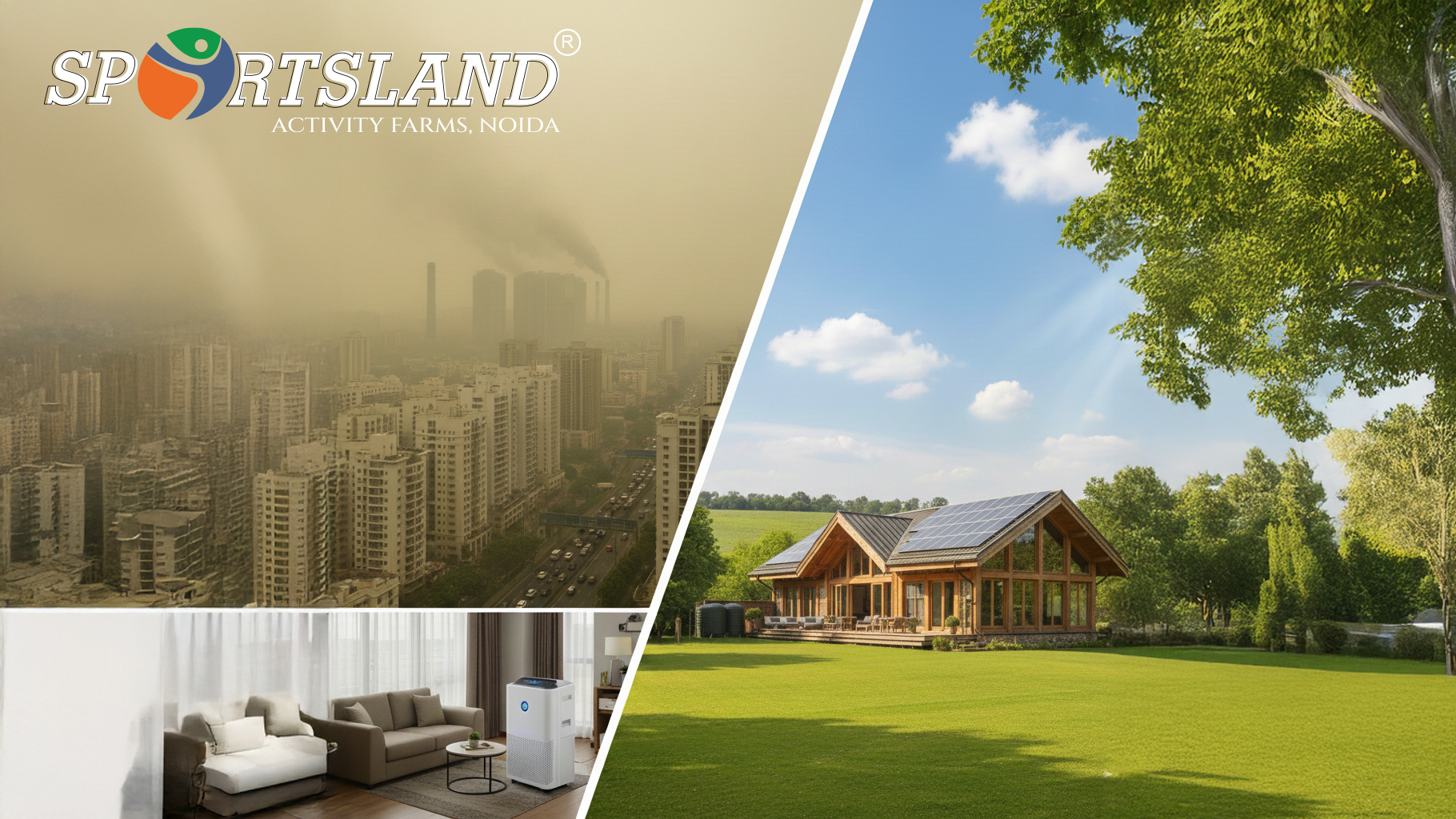
As AQI levels repeatedly breach safe limits and emergency responses like GRAP become routine, families are being forced to reconsider not just how they live—but where they live. The conversation has shifted from short-term coping mechanisms to long-term health-oriented living decisions.
This is why the idea of owning a sustainable farmhouse in Noida Sector 151 is no longer driven by luxury aspirations or weekend living. It is driven by risk mitigation, preventive healthcare, and environmental resilience.
This blog breaks down the verified reality of NCR’s air crisis, explains why indoor air is often as harmful as outdoor air, and explores why low-density, sustainable farmhouse living is increasingly becoming a health-first choice for families.
NCR’s Air Pollution Is Officially a Public Health Emergency
What the Government Defines as “Safe Air”
The Central Pollution Control Board (CPCB) defines India’s air safety limits under the National Ambient Air Quality Standards (NAAQS).
- PM2.5 annual mean limit: 40 µg/m³
- PM2.5 24-hour limit: 60 µg/m³
Delhi-NCR routinely exceeds these benchmarks—often by multiple folds during winter months.
When a region consistently violates these limits, it is categorized as a non-attainment area, triggering long-term policy intervention.
AQI Categories Are Not Advisory — They Are Medical Indicators
The National Air Quality Index (AQI), issued by CPCB, translates pollution data into direct health implications.
- Moderate (101–200): Breathing discomfort for people with respiratory conditions
- Poor (201–300): Prolonged exposure affects most individuals
- Very Poor (301–400): Respiratory illness even for healthy people
- Severe (401–500): Serious health impacts for all
Delhi-NCR frequently records AQI levels in the Very Poor to Severe range.
This means millions are exposed to unsafe air as a daily norm, not an exception.
GRAP: When Breathing Requires Emergency Governance
To manage severe pollution episodes, NCR operates under GRAP (Graded Response Action Plan), enforced by the Commission for Air Quality Management (CAQM).
GRAP measures include:
- School closures
- Construction bans
- Diesel generator restrictions
- Traffic limitations
- Work-from-home advisories
These are emergency interventions, not lifestyle suggestions.
When a region requires emergency governance just to reduce exposure, it forces households to rethink residential choices at a fundamental level.
The Biggest Myth: Indoor Air Is Not Automatically Safe
Many families assume that staying indoors protects them from pollution. Government health advisories caution otherwise.
What Health Authorities Say
The Ministry of Health & Family Welfare (MoHFW) and National Centre for Disease Control (NCDC) clearly state:
- PM2.5 particles penetrate indoors
- Indoor concentrations depend on ventilation, infiltration, and surrounding pollution
- Vulnerable populations—children, elderly, pregnant women—are at higher risk
Indoor air quality is therefore a function of urban design, not just indoor behavior.
Why Apartments Amplify Exposure Risk
High-Density Planning Traps Pollutants
Most NCR apartments are built with:
- High FAR (Floor Area Ratio)
- Closely packed towers
- Limited airflow corridors
Pollutants enter through:
- Windows and balconies
- Lift shafts and basements
- Common areas and ducts
This creates continuous exposure, even when residents remain indoors.
Mechanical Purification Has Limits
Air purifiers:
- Clean only enclosed rooms
- Do not cover kitchens, corridors, or balconies
- Require continuous power and maintenance
The Bureau of Indian Standards (BIS) emphasizes the importance of natural ventilation in residential buildings.
Apartments designed for density struggle to achieve this naturally.

Why Low-Density Living Changes Exposure Outcomes
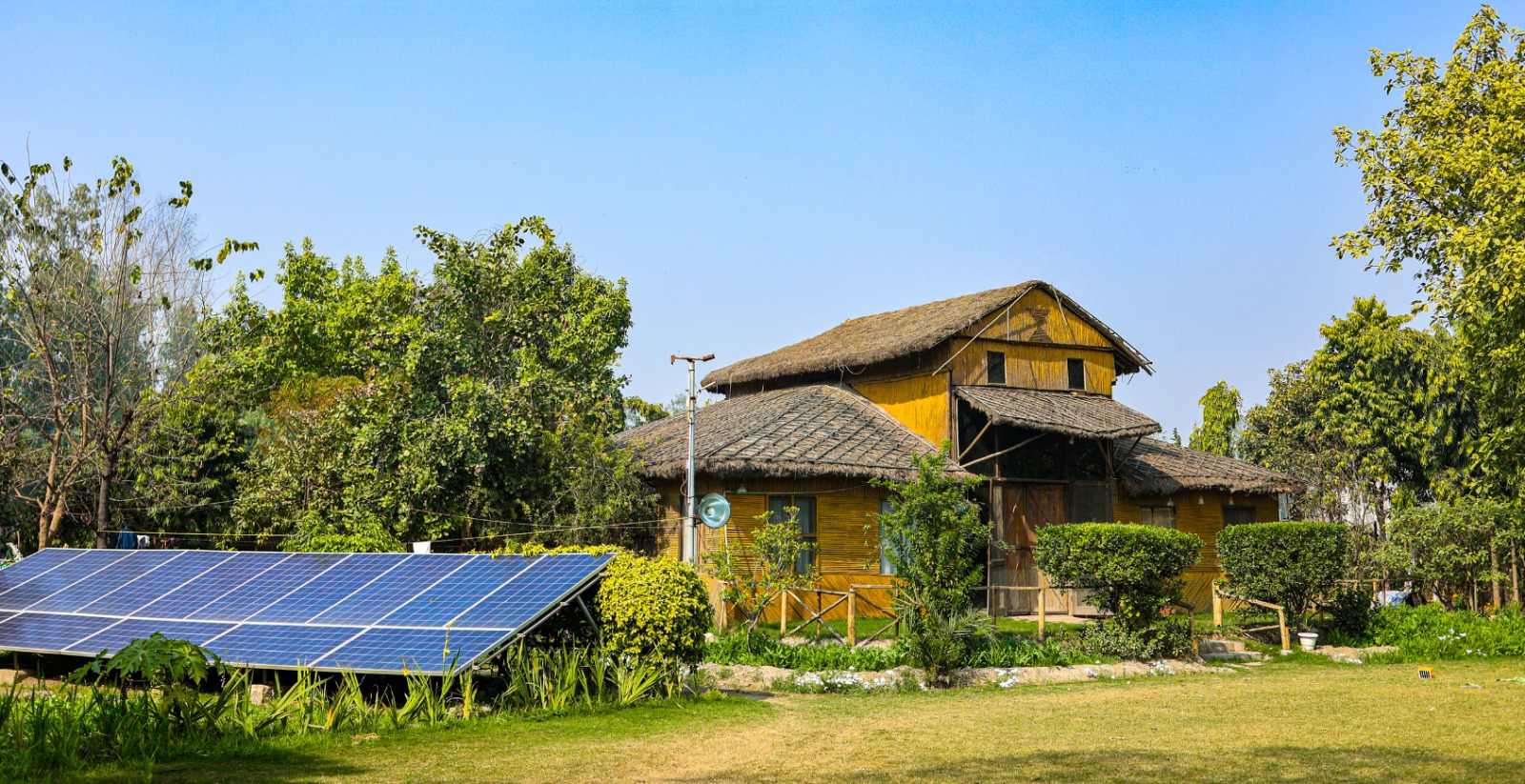
A sustainable farmhouse in Noida Sector 151 offers structural advantages that apartments cannot retrofit.
Distance Reduces Concentration
Pollution intensity drops significantly when:
- There is more horizontal space
- Fewer vehicles per square kilometer
- Less construction activity
Low-density layouts dilute particulate concentration naturally.
Why Sector 151 Noida Is Gaining Attention
Sector 151 offers:
- Strategic access to Noida–Greater Noida Expressway
- Lower congestion compared to central NCR
- Larger land parcels per household
- Reduced vertical development
This makes a sustainable farmhouse in Noida Sector 151 uniquely positioned for connectivity without congestion.
Green Cover Is Functional Infrastructure
According to environmental planning frameworks:
- Trees trap particulate matter
- Green belts reduce dust resuspension
- Vegetation improves microclimate stability
The Ministry of Environment, Forest and Climate Change (MoEFCC) recognizes green infrastructure as critical for urban resilience.
Farmhouse communities with natural landscaping deliver real environmental services, not decorative greenery.
Children, Pollution, and Developmental Risk
Government health advisories highlight:
- Children inhale more air per kilogram of body weight
- Developing lungs are more susceptible to PM2.5 damage
- Pollution restricts outdoor play, increasing screen time
In apartments:
- Outdoors are unsafe
- Indoors are confined
A sustainable farmhouse in Noida Sector 151 restores:
- Safe private outdoor spaces
- Flexible exposure management
- Physical activity and sunlight
Elderly Health and Long-Term Exposure
For seniors:
- PM2.5 worsens cardiovascular conditions
- Repeated exposure increases hospitalizations
- Reduced mobility increases indoor exposure risk
Health advisories emphasize exposure minimization, which is structurally easier in low-density environments.
Sustainability Goes Beyond Air Quality
A sustainable farmhouse in Noida Sector 151 supports holistic health:
1. Air
- Lower baseline pollution
- Better dispersion
- Natural ventilation
2. Soil & Food
- Organic farming
- Reduced chemical exposure
- Nutritional independence
3. Mental Health
- Lower stress
- Connection with nature
- Reduced noise pollution
Government Policy Signals a Long-Term Shift
India’s National Clean Air Programme (NCAP) recognizes:
- Urban form impacts pollution
- Decentralized living reduces pressure on city cores
- Sustainable land use is essential for clean air goals
Farmhouse living aligns organically with these policy objectives.
Investment Logic Meets Health Logic
From a real-estate perspective:
- Health-driven demand is more stable than speculative demand
- Low-density land assets retain long-term value
- Farmhouses offer dual utility: living + appreciation
A sustainable farmhouse in Noida Sector 151 therefore becomes both a health hedge and a legacy asset.
Why This Is Not a Trend — It’s a Correction
Pollution is not improving fast enough.
GRAP is becoming routine.
Health advisories are growing stronger.
Families are adapting faster than cities.
Choosing a sustainable farmhouse in Noida Sector 151 is not about leaving the city—it is about designing life around verified environmental reality.
Health Is the New Luxury
In a region where air quality dictates daily behavior, the most valuable homes are not the tallest or the most central—but the most breathable.
A sustainable farmhouse in Noida Sector 151 offers what apartments cannot engineer later:
- Space
- Distance
- Nature
- Control
In NCR’s new reality, clean air is not an amenity — it is infrastructure.
FAQ
1. Why is indoor air quality a serious concern for families living in Delhi-NCR?
Indoor air quality in Delhi-NCR is a growing concern because fine particulate matter (PM2.5) does not remain outdoors. According to the Ministry of Health & Family Welfare (MoHFW) and National Centre for Disease Control (NCDC), PM2.5 particles easily infiltrate homes through windows, doors, ventilation shafts, and common building ducts. Staying indoors may reduce exposure temporarily, but it does not eliminate health risks, especially in high-density residential clusters.
This is why many families are reconsidering their living environments and exploring options like a sustainable farmhouse in Noida Sector 151, where lower density and open surroundings significantly reduce pollutant concentration.
Source:
https://ncdc.gov.in/showfile.php?lid=513
2. How does Delhi-NCR’s AQI directly affect daily health decisions?
The National Air Quality Index (AQI) issued by the Central Pollution Control Board (CPCB) links pollution levels directly to health outcomes. AQI categories such as Poor, Very Poor, and Severe indicate increasing respiratory stress, even for healthy individuals. Delhi-NCR frequently falls into these categories, meaning prolonged exposure becomes unavoidable for urban residents.
This reality is pushing families to prioritize location and environmental buffers, making a sustainable farmhouse in Noida Sector 151 a preventive lifestyle decision rather than a luxury choice.
3. What is GRAP, and why does it influence housing choices in NCR?
GRAP (Graded Response Action Plan) is an emergency pollution control framework enforced by the Commission for Air Quality Management (CAQM). When AQI worsens, GRAP mandates actions such as school closures, construction bans, vehicle restrictions, and work-from-home advisories.
When a region repeatedly requires emergency governance to manage air quality, families begin to rethink long-term exposure. This is one of the key reasons demand is rising for low-density living options like a sustainable farmhouse in Noida Sector 151.
4. Why are children more vulnerable to air pollution than adults?
Government health advisories highlight that children inhale more air per kilogram of body weight than adults, making them more susceptible to air pollutants. Their lungs and immune systems are still developing, and prolonged exposure to PM2.5 can affect respiratory health and cognitive development.
Apartments often restrict outdoor play during high AQI days, increasing screen time and sedentary behavior. A sustainable farmhouse in Noida Sector 151 allows controlled outdoor activity, cleaner baseline air, and safer exposure windows for children.
5. Is air pollution a seasonal issue or a long-term structural problem in NCR?
Air pollution in NCR is no longer limited to winter months. According to CPCB data and the National Clean Air Programme (NCAP), particulate pollution has become a year-round challenge, aggravated by urban density, construction, traffic, and regional factors.
This shift confirms that pollution is structural, not seasonal—making permanent lifestyle changes, such as moving to a sustainable farmhouse in Noida Sector 151, a more rational response than temporary coping mechanisms.
6. How does low-density living reduce pollution exposure?
Low-density living reduces pollution exposure by:
- Increasing physical distance from emission sources
- Improving air dispersion
- Allowing natural ventilation
- Supporting green buffers that trap particulate matter
Unlike vertical apartments, a sustainable farmhouse in Noida Sector 151 benefits from horizontal planning, fewer shared air corridors, and larger open spaces, all of which contribute to better baseline air quality.
7. Can air purifiers alone make apartment living safe in NCR?
Air purifiers help reduce indoor pollutants but have clear limitations. They typically cover only one enclosed room, require continuous electricity, and do not address pollution entering through balconies, kitchens, corridors, or common areas.
The Bureau of Indian Standards (BIS) emphasizes natural ventilation as a key component of healthy indoor air—something high-density apartments struggle to provide. This is why many families are choosing a sustainable farmhouse in Noida Sector 151, where ventilation is structural, not mechanical.
8. Why is Sector 151 Noida emerging as a preferred location for farmhouses?
Sector 151 offers a rare balance of connectivity and low congestion. It is strategically located near the Noida-Greater Noida Expressway while maintaining lower population density compared to central NCR zones.
This makes a sustainable farmhouse in Noida Sector 151 attractive for families who want access to urban infrastructure without daily exposure to urban pollution intensity.
9. How does sustainable farmhouse living support long-term health beyond air quality?
Sustainable farmhouse living supports holistic health by improving:
- Air exposure through dispersion and greenery
- Mental health via reduced noise and stress
- Physical activity through open spaces
- Nutrition through organic or home-grown produce
Government environmental and public health frameworks increasingly recognize that built environment influences long-term health outcomes, making a sustainable farmhouse in Noida Sector 151 a comprehensive wellness choice.
10. Is investing in a sustainable farmhouse a financially sound decision?
From a long-term perspective, health-driven real estate demand is more resilient than speculative demand. Low-density land assets near NCR tend to retain value due to limited supply, increasing environmental awareness, and changing lifestyle priorities.
A sustainable farmhouse in Noida Sector 151 offers dual value:
- Immediate lifestyle and health benefits
- Long-term land appreciation and legacy ownership
This aligns with broader shifts toward sustainable and responsible development.
Ready to Choose Health Over Compromise?
Air quality in NCR is no longer a distant concern—it is shaping how families live, work, and raise their children. Government data, health advisories, and emergency policies all point to one truth: exposure matters, and design matters.
A sustainable farmhouse in Noida Sector 151 is not about escaping the city—it’s about building a healthier future within reach of it. With cleaner air, open land, low density, and nature-integrated living, it offers what apartments simply cannot retrofit.
If you’re evaluating long-term health, lifestyle security, and legacy value for your family, now is the time to explore sustainable farmhouse living—before clean air becomes the rarest luxury of all.
👉 Schedule a site visit
👉 Speak to our sustainability and planning experts
👉 Discover how healthy land creates healthy living
Your future deserves more than closed windows and air purifiers.
It deserves space, nature, and breathable living.