Active Lifestyle Communities Near Noida: Rethinking Urban Living in an Age of Sedentary Design
Urban India has transformed dramatically over the last two decades. High-rise towers have redefined skylines, gated clusters have increased security, and convenience has become the defining promise of modern housing. Yet quietly, another shift has been unfolding alongside this growth: daily movement has reduced.
The conversation today is no longer only about square footage, finishes, or proximity to expressways. It is about how a place shapes daily habits. Increasingly, families, professionals, and long-term investors are asking whether their environment encourages vitality or subtly discourages it. This is where the idea of active lifestyle communities near Noida becomes relevant.
This discussion is not about criticising high-rise living, nor about questioning legality, location, or development standards. High-rise urbanisation has solved housing demand efficiently and legally. The issue is not compliance. The issue is lifestyle architecture. As global health institutions emphasise, the built environment directly influences physical activity levels. According to the World Health Organisation (WHO), adults should accumulate 150–300 minutes of moderate-intensity physical activity weekly for substantial health benefits. Yet globally, insufficient physical activity remains a leading risk factor for noncommunicable diseases.
When daily life reduces natural movement, even well-intentioned individuals struggle to meet these recommendations. That is why active lifestyle communities near Noida are increasingly being explored—not as a trend, but as a structural solution to modern sedentary design.
The Structural Nature of Sedentary Living
Sedentary living is often framed as a personal failure. In reality, it is frequently a design outcome.
Consider a typical day in many high-density urban clusters:
- Elevator instead of stairs
- Basement parking to office parking
- Delivery instead of walking to a store
- Screen-based leisure instead of outdoor socialisation
None of these is inherently negative. They represent progress and convenience. But cumulatively, they remove incidental movement from everyday life.
The WHO Global Status Report on Physical Activity 2022 emphasises that countries must move beyond individual-level campaigns and instead improve “systems and environments that support physical activity.”
This marks a policy-level acknowledgement: behaviour follows environment.
When environments are walkable, green, safe, and socially active, people move more without planning to. When environments are car-dependent and vertically isolated, movement becomes optional.
This is precisely the lens through which active lifestyle communities near Noida are being evaluated today. They are not about gyms. They are about spatial intelligence.
Why the Conversation Matters More After 35
For younger individuals, inactivity may feel reversible. For those above 35, patterns compound. Mobility, metabolic health, bone density, balance, and cardiovascular resilience depend heavily on consistency.
A large population-based study in India published in BMJ Open examined physical inactivity among adults aged 45 and above using nationally representative data. The findings showed substantial levels of insufficient activity in middle-aged and older adults.
This has long-term implications:
- Reduced mobility with age
- Higher risk of lifestyle-related health challenges
- Lower independence in later decades
The question, therefore, shifts from “Do I exercise?” to “Does my living environment make regular movement sustainable for the next 20 years?”
This is where active lifestyle communities near Noida enter the discussion as long-horizon decisions rather than short-term lifestyle upgrades.
Built Environment as Preventive Infrastructure
Globally, research increasingly connects walkability with physical activity levels. Urban planning is now seen as a public-health lever.
The WHO guidelines summary published in the British Journal of Sports Medicine reinforces the importance of environments that enable regular moderate-intensity activity rather than relying only on vigorous workouts.
Source: BJSM Summary – https://bjsm.bmj.com/content/54/24/1451.full.pdf
In practical terms, this means:
- Safe pedestrian pathways
- Continuous walking loops
- Accessible green spaces
- Multi-generational outdoor areas
When such elements are integrated into residential planning, they reduce friction between intention and action.
That is the fundamental principle behind active lifestyle communities near Noida: design that encourages movement without requiring extraordinary motivation.
What Defines Active Lifestyle Communities Near Noida?
The phrase is sometimes misunderstood as marketing language. In reality, it refers to measurable spatial characteristics.
Active lifestyle communities near Noida typically demonstrate:
1. Functional Walkability
Not decorative jogging tracks, but connected pedestrian pathways that integrate daily life.
2. Proximity to Open Greens
Green space within walking distance of homes—not only at periphery edges.
3. Multi-Generational Design
Spaces for children’s unstructured play and safe, even surfaces for senior walking.
4. Reduced Internal Car Dependence
Design that encourages short-distance walking within the community.
5. Outdoor Social Infrastructure
Benches, shaded areas, and gathering spaces that normalise evening walks and conversations.
When evaluating active lifestyle communities near Noida, these tangible features matter more than brochure language.
Children, Screens, and Shrinking Play Radius
One of the most overlooked aspects of sedentary urban life is childhood movement.
WHO guidelines emphasise regular moderate-to-vigorous activity for children and adolescents. Yet urban safety concerns, limited open space, and digital entertainment have reduced spontaneous outdoor play.
Children do not require high-performance sports facilities to be active. They require proximity, safety, and peer presence.
In active lifestyle communities near Noida, children’s movement often becomes natural because:
- Other children are outdoors
- Green space is visible and accessible
- Parents feel secure
This reduces the need for scheduled activity and restores unstructured play—an important developmental pillar.
The Social Capital Effect
Physical activity is not the only outcome of walkable environments. Social interaction increases.
Casual greetings during evening walks, seniors sitting outdoors, children playing in shared greens—these build social trust. While not easily quantified, this social capital influences long-term satisfaction and mental well-being.
The WHO global report underscores the need for multi-sector action and community-level support systems to reduce inactivity.
Environments that support movement also support interaction.
This broader lens is why investors and long-term planners are beginning to examine active lifestyle communities near Noida through both wellness and social sustainability frameworks.
The Economic Perspective: Long-Term Value
For HNIs, NRIs, policymakers, and investors, lifestyle is not separate from value.
Properties designed around movement and green integration may demonstrate:
- Higher livability scores
- Stronger long-term occupancy
- Multi-generational usability
- Lower lifestyle friction
As urban stress and air-quality awareness increase, demand for environments that integrate greenery and outdoor movement may strengthen over time.
Importantly, this discussion does not diminish traditional developments. It simply highlights that lifestyle design may influence long-term desirability.
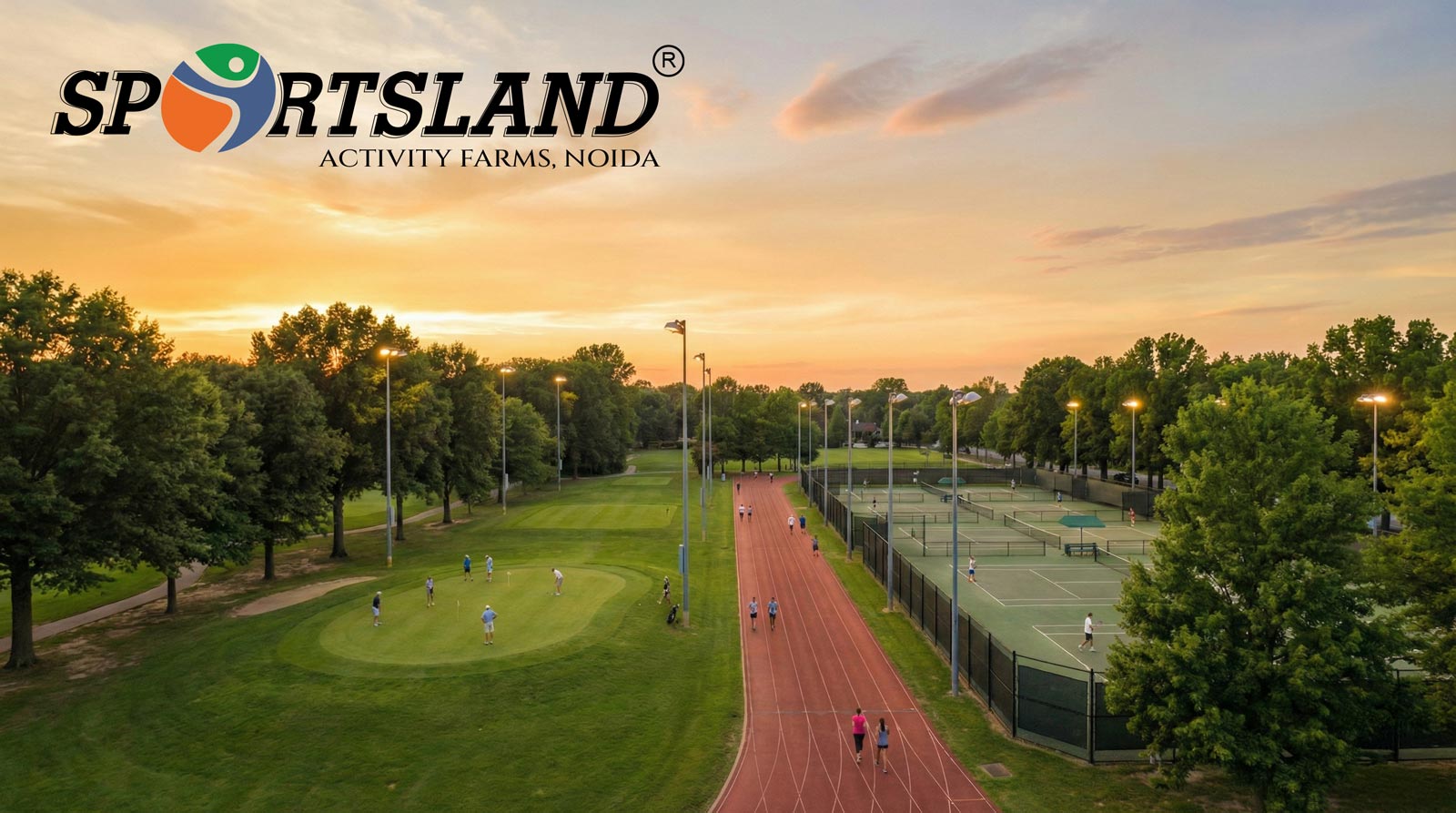
Some projects within the region—including Sportsland—have incorporated open-air movement districts and integrated green spaces to address these structural shifts. This is not a promotional claim, but an example of how planning philosophies are evolving.
The conversation around active lifestyle communities near Noida is therefore not speculative. It aligns with global public-health direction and long-term demographic realities.
Ageing with Independence
Independence in later decades depends heavily on mobility.
WHO includes balance-focused recommendations for older adults and highlights the importance of physical activity in reducing fall risk.
In environments where seniors feel unsafe walking outdoors, independence declines faster. In environments that encourage daily walking, independence may extend longer.
For families planning legacy assets, this matters.
Active lifestyle communities near Noida, therefore, represent not only a lifestyle decision but potentially a resilience decision.
Practical Evaluation Framework
If exploring active lifestyle communities near Noida, consider:
- Can I walk comfortably for 20 minutes without interruption?
- Do I see seniors walking independently?
- Are children naturally outdoors after school hours?
- Is greenery usable year-round?
- Does the layout reduce car dependency within the premises?
- Will this environment remain supportive in my 60s?
These questions move the conversation beyond amenities toward lived experience.

A Balanced View
It is important to reiterate: this discussion does not criticise high-rise urbanisation, legal compliance, or project integrity. Many developments across NCR are legally robust, strategically located, and architecturally sound.
The question here is narrower: how does design influence daily movement?
As global health frameworks increasingly acknowledge, environments shape behaviour. The shift toward active lifestyle communities near Noida reflects awareness of this connection.
Reframing “Better Living”
For years, modern living equated success with convenience and vertical growth. Today, a complementary definition is emerging:
Better living may also mean:
- Space to move
- Access to green
- Safe pedestrian culture
- Outdoor social rhythms
In this context, active lifestyle communities near Noida represent a structural rebalancing—integrating movement into daily life rather than isolating it in gyms.
FAQ
1. What are active lifestyle communities near Noida?
Active lifestyle communities near Noida are residential ecosystems intentionally designed to encourage everyday physical movement through walkability, accessible green spaces, pedestrian-friendly layouts, and multi-generational outdoor areas.
Unlike conventional housing, where exercise requires planning, these communities integrate movement into daily life through walking loops, open-air activity zones, and proximity-based design.
Global health institutions increasingly recognise that the built environment significantly influences physical activity levels. According to the World Health Organisation (WHO), environments that support walking, cycling, and access to public spaces play a critical role in reducing inactivity.
2. Why is sedentary living considered a growing concern in urban areas?
Sedentary living has become common due to elevator use, car dependency, desk-based work, and digital entertainment. Over time, reduced incidental movement contributes to higher risks of noncommunicable diseases.
The WHO identifies physical inactivity as a leading risk factor for global mortality and recommends adults accumulate 150–300 minutes of moderate-intensity activity weekly.
When daily environments do not naturally encourage walking or outdoor activity, meeting these recommendations becomes more difficult.
3. How do active lifestyle communities near Noida differ from high-rise apartment clusters?
High-rise clusters are efficient and legally structured solutions to urban density. However, many are vertically designed, with limited pedestrian integration at ground level.
In contrast, active lifestyle communities near Noida prioritise horizontal movement corridors, usable green spaces, and reduced internal car dependency.
The difference is not about legality or quality—it is about how spatial planning influences movement behaviour.
4. Are active lifestyle communities near Noida only about gyms and sports facilities?
No. While amenities may include sports infrastructure, the defining feature of active lifestyle communities near Noida is everyday movement—not performance fitness.
The WHO guidelines emphasise consistent moderate activity over sporadic high-intensity workouts.
The goal is to make walking, stretching, playing, and social outdoor activity a natural part of daily life.
5. Why are active lifestyle communities near Noida especially relevant for people above 35?
After 35, long-term mobility and metabolic health depend heavily on consistency. Regular moderate activity supports cardiovascular function, bone density, and balance.
A large study published in BMJ Open found significant levels of physical inactivity among middle-aged and older adults in India.
Environments that reduce friction for daily walking may therefore support healthier ageing.
6. How do active lifestyle communities near Noida benefit children?
Children today experience increased screen exposure and reduced outdoor play. WHO recommends regular moderate-to-vigorous activity for children and adolescents to support physical and mental development.
Active lifestyle communities near Noida often provide safe, proximate green areas that encourage unstructured play, helping children develop coordination, resilience, and social skills.
7. Do active lifestyle communities near Noida have long-term investment value?
From an investor’s perspective, properties that align with long-term demographic trends—such as ageing populations and increased health awareness—may sustain demand.
As urban stress, pollution awareness, and sedentary lifestyles become more visible concerns, environments designed around green integration and walkability may hold enduring appeal.
While value depends on multiple factors, including location and infrastructure, lifestyle design increasingly influences desirability.
8. Are active lifestyle communities near Noida suitable for senior citizens?
Yes, when properly designed. Senior-friendly features include even walking surfaces, shaded pathways, seating areas, and safe pedestrian circulation.
WHO includes balance and mobility activities in its recommendations for older adults, highlighting the importance of safe environments.
Communities that encourage safe outdoor presence may help seniors maintain independence longer.
9. How can one evaluate whether a community truly supports active living?
When assessing active lifestyle communities near Noida, consider:
- Are walking paths continuous and safe?
- Is green space easily accessible from residences?
- Do children naturally play outdoors?
- Are seniors comfortable walking independently?
- Does the layout reduce unnecessary vehicle use?
Real active living is visible in daily behaviour—not only in marketing materials.
10. Is choosing active lifestyle communities near Noida a lifestyle decision or a structural one?
It is both. Lifestyle decisions often compound over decades. Environments that integrate movement may reduce long-term health risks, support social engagement, and enhance overall well-being.
Global public-health frameworks increasingly stress the importance of environmental design in addressing inactivity.
Choosing active lifestyle communities near Noida is therefore less about short-term convenience and more about aligning living environments with long-term vitality.
Designing for the Next 20 Years
Urban India will continue to grow upward. Infrastructure will expand. Expressways will improve connectivity. High-rise living will remain a necessary and efficient response to population density. None of that is in question. What is evolving, however, is how we define long-term quality of life within that growth.
Over the next 20 years, demographic realities will reshape housing priorities. India’s population is ageing steadily. Professionals in their 30s and 40s today will be in their 50s and 60s within two decades. Children growing up in digital-first environments will become adults shaped by screen-dominant routines. In that context, the design of residential ecosystems becomes more than an aesthetic choice—it becomes a structural influence on health, independence, and social vitality.
The World Health Organisation has repeatedly emphasised that physical inactivity is a major global health risk and that environments must be redesigned to enable movement rather than merely advise it. The conversation is no longer about telling people to exercise more; it is about building communities where movement is woven into daily life.
When thinking 20 years ahead, the real question is not, “Is this property impressive today?” but rather:
- Will I still feel comfortable walking here at 60?
- Will my parents feel safe stepping out alone?
- Will children growing up here naturally spend time outdoors?
- Does this environment reduce dependency on vehicles within the community?
- Is green space usable, accessible, and functional year-round?
These questions go beyond amenities. They address the sustainability of lifestyle.
Over time, small daily habits compound. Twenty minutes of walking each evening may not feel dramatic, but multiplied over 20 years, it becomes thousands of hours of accumulated movement. The same applies to children’s outdoor play or seniors maintaining balance and mobility. Environments that remove friction from these habits quietly support long-term resilience.
This is why the conversation around active lifestyle communities near Noida is increasingly framed not as a luxury preference but as preventive infrastructure. Built environments influence cardiovascular health, mental well-being, social interaction, and ageing independence. Global policy direction acknowledges this reality. Residential design is no longer separate from public health thinking.
From an investment standpoint, this perspective introduces another dimension: adaptability. Communities that support multi-generational use—children today, ageing adults tomorrow—may sustain relevance longer than those designed only for a narrow life stage. Livability increasingly influences long-term desirability.
It is important to emphasise that this discussion does not criticise conventional high-rise developments or question their legality, quality, or contribution to urban progress. High-rise housing has solved critical supply challenges and continues to play a vital role in NCR’s growth. The conversation here is simply about complementing vertical efficiency with horizontal vitality.
Designing for the next 20 years means acknowledging that:
- Health is cumulative.
- Mobility is freedom.
- Social connection is resilience.
- Outdoor access is not ornamental—it is functional.
When evaluating active lifestyle communities near Noida, the true measure is not the brochure—it is the behaviour the environment enables. Are people outside? Are they walking? Are children playing freely? Are seniors participating in daily life with confidence?
In the coming decades, the most successful residential ecosystems may be those that quietly restore what urban speed has reduced: space to move, breathe, and interact naturally.
Ultimately, designing for the next 20 years is about building environments that work with human biology, not against it. It is about recognising that architecture shapes habit, and habit shapes health.
And that awareness—more than any short-term feature—may define the future of urban living near Noida.