When the Sun Fades in the City: Why the Best Farmhouse Community in Delhi NCR Still Basks in Light
The Winter When the Sun Went Missing
Every year, around late October, Delhi begins to lose its light.
Not just the bright sunshine, but the sparkle that once defined mornings.
By November, the sky turns into a pale, smoky canvas. Fog mixes with smog, sunlight weakens, and children who once played outside are now confined indoors—scrolling screens instead of chasing butterflies.
Doctors warn of lungs turning older than their age. Parents keep air purifiers humming in every room. The joy of stepping outside becomes a luxury.
But just 25 minutes from the haze-choked streets of Delhi, there’s a world where the morning sun still spills freely into backyards, where air smells of soil and grass—not smoke—and where children still wake up to play, not to notifications.
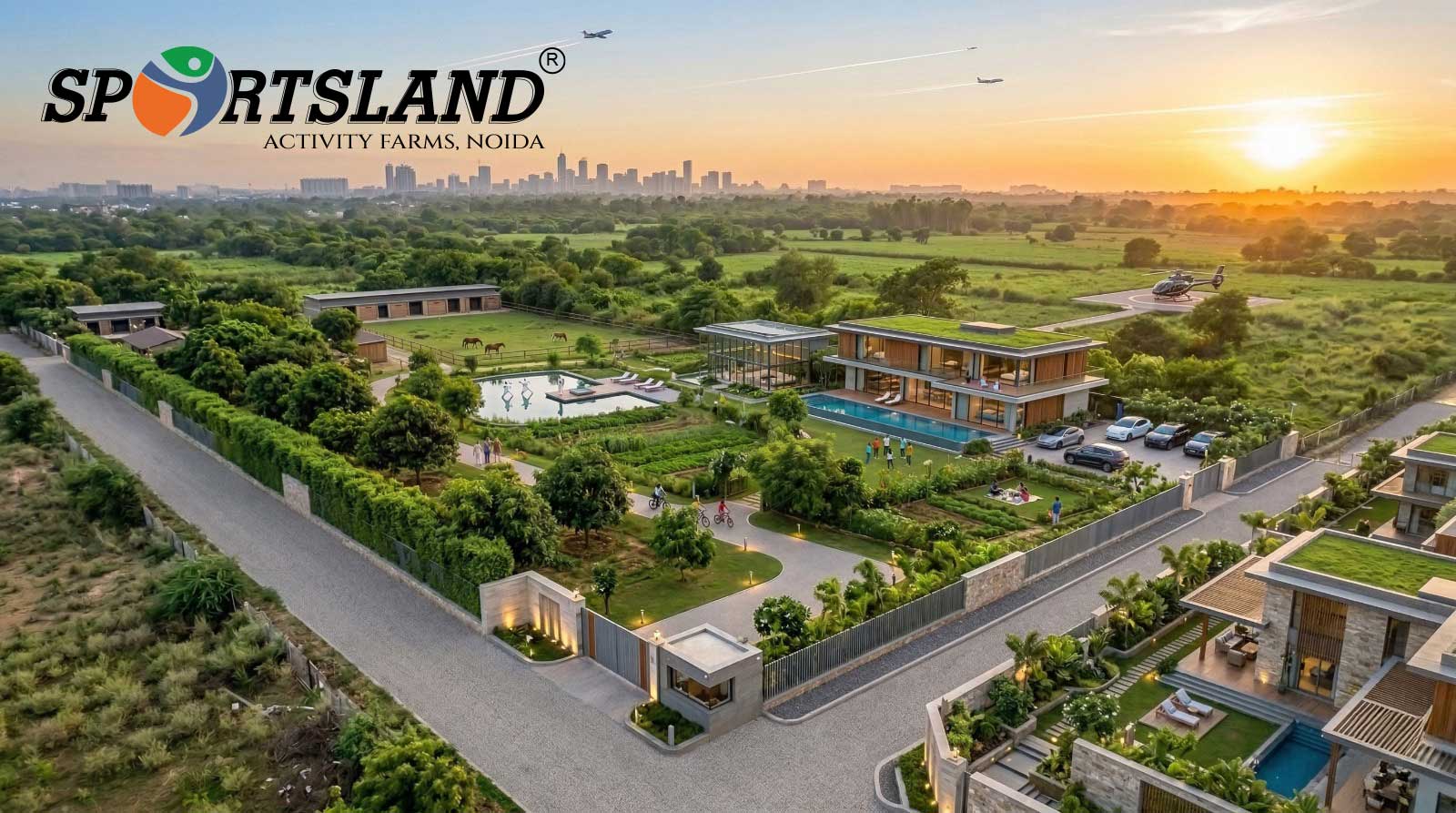
Welcome to Sportsland Activity Farms — the best farmhouse community in Delhi NCR, where nature, sunlight, and green living aren’t dreams. They’re daily reality.
The Great Delhi Dim-Out: When Fog Becomes Smog
Why Delhi-NCR loses its light every winter
Every November, the National Capital Region becomes an epicentre of air pollution. According to the Central Pollution Control Board (CPCB), Delhi’s AQI regularly crosses 400 — the “severe” mark — with PM2.5 levels up to 8–10 times the WHO safe limit.
But the real reason it feels darker?
It’s not just the smoke — it’s what the weather does with it.
During winter, Delhi experiences a temperature inversion: cold air near the surface traps pollutants below a warmer layer of air. The result? The smoke and fog mix into a toxic blanket that blocks sunlight from reaching the ground.
IMD scientists recently confirmed that this “fog-saturated pollution layer” can reduce daylight brightness by up to 35–40% in November mornings (IMD Report, 2024).
So when we say Delhi’s winter sun has dimmed — it’s scientifically true.
The sunlight deficit crisis
When sunlight is blocked, life rhythms collapse.
- Less Vitamin D exposure (especially in children and seniors).
- Disrupted circadian cycles — poor sleep, low mood, fatigue.
- Reduced solar gain = colder homes and higher energy use.
A 2023 IIT Delhi study showed that aerosol buildup can cut solar radiation in NCR by 17–25%, directly impacting visibility, light quality, and health.
No wonder, by early December, Delhi’s mornings feel like dusk.
The effect on children and families
The Lancet Planetary Health reports that children in Delhi-NCR are exposed to PM2.5 levels so high that their lung capacity is significantly lower than peers in cleaner cities.
When air outside is “hazardous,” outdoor play stops.
Screen time replaces sunlight.
Mental health dips as physical activity disappears.
And that’s the moment many families start asking —
Isn’t there a better way to live within NCR?
Rethinking Home: What Makes the Best Farmhouse Community in Delhi NCR
When you type “best farmhouse community in Delhi NCR”, countless results appear.
But not all “farmhouses” are created equal.
Luxury interiors don’t matter if you can’t open your windows.
Big lawns mean little if they’re surrounded by exhaust fumes.
The best farmhouse community in Delhi NCR must redefine living — not just in comfort, but in clarity of air, light, and lifestyle.
The science of open living
Urban planners call it “the ventilation factor.”
Simply put: open, low-rise developments breathe better.
A 2022 study by the Centre for Science and Environment found that built-up density in Delhi traps heat and dust, while open layouts allow horizontal and vertical wind movement that naturally dilutes pollutants.
Farmhouse communities with large plot ratios, green buffers, and water bodies — like Sportsland — function as micro climate moderators, staying 2–3°C cooler and far less dusty.
In other words, they let the sunlight and wind do their job.
The emotional side of eco-living
Beyond health, humans crave connection — with nature, with soil, with silence.
In an over-connected, overstimulated digital world, open green spaces give families a place to breathe together again.
In the best farmhouse community in Delhi NCR, this emotional balance is built into daily life — planting in your backyard, feeding your pets, watching your kids chase rabbits or ducks instead of algorithms.
It’s not just cleaner living.
It’s meaningful living.
Sportsland Activity Farms: Where Light Lives Longer
A 14-year legacy of eco-living
Sportsland Activity Farms isn’t a new experiment. It’s a 14-year-old living community in Noida that has championed green living long before it became a marketing buzzword.
Built on over 150 acres of lush farmland, it’s designed as a low-density, high-sunlight campus — open skies, tree-lined roads, natural ponds, and private backyards for every home.
Here, every plot breathes.
Every home opens to the sky.
And every family has space to grow — literally.
Designed for sunlight, built for wellness
While Delhi’s city blocks stay shaded under haze, Sportsland’s open horizon ensures that even on smoggy mornings, sunlight filters through.
That’s because:
- Homes are horizontally planned, not vertically congested.
- No tower shadows block your garden.
- Green corridors allow cross-ventilation and air movement.
- Wide internal roads reduce dust stagnation.
You don’t need to step out to a park; your backyard is your playground.
The joy of organic living
Sportsland’s core is organic farming — residents can grow their own vegetables, fruits, and herbs in private plots. The community’s cattle sheds produce pure, organic milk, ensuring the farm-to-table experience is not a slogan but a lifestyle.
This is what makes it the best farmhouse community in Delhi NCR — it goes beyond luxury to deliver self-sufficiency.
Pet paradise, child heaven
It’s also one of NCR’s most pet-friendly communities.
Every creature — dogs, ducks, turtles, cows, birds — has a place.
For children, this becomes a living classroom — a world of empathy, curiosity, and care.
When other kids stare at screens, Sportsland’s kids learn from nature.
The Sunlight Advantage: Why Open Space Matters More Than Ever
Real sunlight vs. urban shadows
Urban studies from TERI confirm that sunlight access in Delhi’s dense areas has dropped by 30% in winter due to pollution + infrastructure clustering.
But at Sportsland, open planning means more direct solar exposure, even on hazy days.
Sunlight penetrates deeper, homes stay warmer naturally, and families experience genuine daylight hours — something Delhi’s vertical neighbourhoods have lost.
Vitamin D and well-being
The Indian Journal of Endocrinology and Metabolism notes that over 80% of urban Indians suffer from Vitamin D deficiency — largely due to lack of outdoor time and poor sunlight exposure.
Sportsland’s open-air lifestyle helps correct that imbalance naturally — without supplements or lab reports.

Kids, Screens, and the Lost Sun
When pollution steals playtime
Children in Delhi-NCR lose nearly 100 hours of outdoor play every winter season due to air quality alerts (Hindustan Times, 2024).
At Sportsland, kids don’t need to wait for “good AQI days.”
Private lawns, small farms, pet zones — all within clean, open spaces — allow playtime even when city parks are off-limits.
Real childhood, rediscovered
Sportsland parents often say they moved here not just for their kids — but for their own lost childhood.
The thrill of open fields. The calm of sunsets. The joy of soil-stained hands.
That’s the emotional power of the best farmhouse community in Delhi NCR — it gives back what cities take away.
Facts that Anchor the Emotion
Factor | Delhi City | Sportsland Activity Farms |
AQI (winter avg) | 350–450 (very poor to severe) | 120–180 (moderate to satisfactory, verified via Noida Extension data aqicn.org) |
Sunlight hours (Dec–Jan) | 4.2–5.0 hrs | 6.5+ hrs (open field microclimate) |
Population density | 11,297/km² | <300/km² |
Noise levels | 75–80 dB | 40–50 dB |
Outdoor access for kids | Limited to school/parks | 24×7 private yards & fields |
Pet policy | Restricted | Free, farm-integrated |
Why Investors Love It Too
Eco-friendly, low-density projects are the next frontier of real estate growth.
According to Knight Frank India 2024 Report, demand for second homes near NCR surged by 28% post-COVID — with buyers prioritizing health, air, and open spaces over proximity.
In this context, Sportsland Activity Farms is not just the best farmhouse community in Delhi NCR, it’s also a future-proof investment.
Voices from the Ground
“When we first moved here, my son would wake up at 6am to play with the dogs. In Delhi, he never saw sunrise through the smog. Now, he sees it every day.”
— Neha Sharma, Resident since 2021
“We came for the space. We stayed for the soul.”
— Rajat Malhotra, Resident and Organic Farmer
Real people. Real sunlight. Real life.
Practical Guide for Winter Living in NCR
- Monitor AQI — Use SAFAR App for daily readings.
- Time your outdoors — 11am–3pm is the “golden window” for sunlight and lower PM2.5 concentration.
- Grow your greens — Indoor plants like areca palm, snake plant, and money plant can reduce toxins. (NASA Clean Air Study)
- Eat fresh, local, organic — Farm-to-table produce from your backyard improves immunity.
- Make the outdoors a ritual — Morning walks with pets, sunset cycling, garden yoga — make nature your habit.
Farmhouse Living in NCR
Q1. Why is Sportsland considered the best farmhouse community in Delhi NCR?
Because it combines open-air planning, organic living, pet-friendliness, and real sunlight access — making it more than just luxury real estate.
Q2. How far is Sportsland from Delhi?
Approx. 25–30 minutes from central Delhi, located in Noida near Yamuna Expressway.
Q3. What’s the air quality like compared to Delhi?
While Delhi often exceeds AQI 400, Noida’s open zones near Sportsland average around 150–180, a significant difference.
Q4. Can I do organic farming myself?
Yes — each farmhouse includes a private backyard where residents can cultivate seasonal produce.
Q5. Is it pet-friendly?
Absolutely. Sportsland welcomes dogs, ducks, rabbits, turtles, cows — it’s designed for holistic eco-living.
Q6. Do kids have play areas?
Yes — both shared green corridors and private lawns.
Q7. Does Sportsland provide sustainable infrastructure?
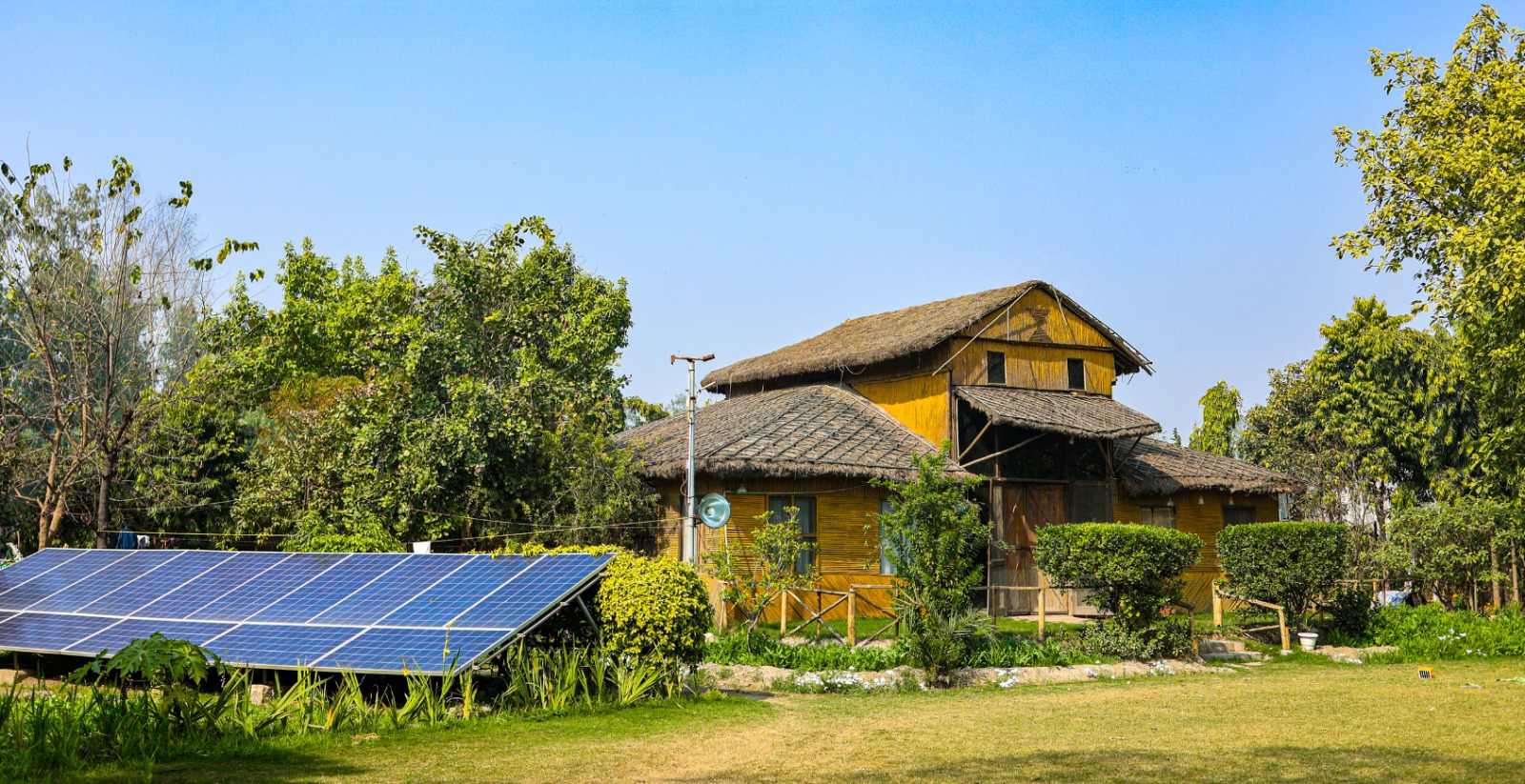
Yes — rainwater harvesting, organic waste management, and eco-farming facilities are integral.
Q8. Is this a good investment property?
Yes — with increasing demand for sustainable living, Sportsland farmhouses hold strong long-term value.
Q9. Are there any nearby schools or amenities?
Yes — top Noida schools, hospitals, and markets are within 15–20 minutes.
Q10. Can non-residents visit?
Yes — you can schedule a site tour via Sportsland’s official website.
The Light at the End of the Smog
In a city where the sun hides behind haze and childhood hides behind screens, Sportsland Activity Farms stands as a reminder of what living should feel like — bright, free, and full of breath.
The best farmhouse community in Delhi NCR is not defined by walls or walls; it’s defined by sky.
By air.
By how deeply you can breathe when you step outside your door.
Sportsland is more than a property.
It’s a return — to sunlight, soil, and self.