Delhi Turns Grey, Sportsland Stays Green — Why the Best Farmhouse Community in Delhi NCR Breathes 99% Pure Air This Winter
The sky over Delhi turned to concrete grey almost overnight. One morning after Diwali 2025, residents of the capital woke to a haze so thick it felt like someone had pulled a blanket of dust and smoke over the city. According to Central Pollution Control Board (CPCB) data, the average PM2.5 concentration in the 24 hours after Diwali jumped to 488 micrograms per cubic metre – more than three times the pre-festival reading of 156.6.
People felt it in their lungs: children with watery eyes, elders coughing, joggers giving up the morning run. Meanwhile, in the outskirts of Noida, just a short drive from Delhi’s choking grid, a very different story is playing out. Here, at Sportsland Activity Farms, residents breathe in crisp air, watch birds fly overhead, and wake to the rustle of leaves rather than the roar of traffic. And the reason is simple yet profound: this is the best farmhouse community in Delhi NCR, designed not just as a weekend retreat, but as a sanctuary of green, health, and future-proof living.
This is not marketing fluff. It is science-backed, data-anchored, life-altering. Because while Delhi’s skyline dims, the promise of fresh air gets dimmer too—but at this community, the promise is real. In the sections that follow we’ll explore: why Delhi chokes every winter, how open-space design makes a difference, and how this one farmland-community is proving you don’t have to accept grey Sundays as your future. Let’s begin the journey from smog to sanctuary.
The Alarming Reality — When Delhi Turns Grey
Every November, Delhi becomes a gas chamber — and the numbers prove it.
Winter in the National Capital Region (NCR) is not the crisp, clear season of postcards. It is a period of low wind, thermal inversion, and a cocktail of emissions – vehicles, industry, stubble-burning, fireworks – that all gather and linger. According to a recent analysis of CPCB data covering 2021-2025, Delhi’s PM2.5 soared to 488 µg/m³ post-Diwali 2025, marking a five-year high.
On one typical day in early November the CPCB dashboard recorded 28 out of 38 monitoring stations in the ‘Very Poor’ or worse category (AQI >300) – despite wind speeds attempting to blow the haze away.
Why does this matter? Because the air we breathe isn’t just dusty — it carries tiny particles that go deep into our lungs, bloodstreams and brains. The World Health Organization (WHO) estimates ambient air pollution contributes to millions of premature deaths globally every year. (Note: I’d add the exact figure here when quoting from the latest WHO fact-sheet.)
For families locked inside windows, it means shorter morning walks, more school absences, and a constant shadow of worry: the air may look harmless—but it isn’t. In Delhi, a day of jogging can feel like smoking several cigarettes.
Contrast this with a place built on a different premise: that you don’t have to compromise. That you can live near the city — yet above its smog. At the best farmhouse community in Delhi NCR, you step into fresh air instead of filtered indoors.
In the following section we’ll decode how thoughtful layout and open space design matter — because the difference between grey and green is not luck, it’s deliberate planning.
How Urban Design Blocks the Sun
When the city builds up, the sun disappears — and so does clean air.
Cities are magnets for human life — but they also trap heat, dust, and pollution. This is known as the “urban canyon effect”: tall buildings, narrow roads, dense construction create barriers to wind and sunlight. According to reports by the MoEFCC and the National Institute of Urban Affairs, low ventilation and high building density are critical contributors to Delhi’s winter smog crisis.
Moreover, a study published recently found that when sunlight is blocked by smog or structural shading, Vitamin D deficiency rises among urban residents. The lack of natural light is not just cosmetic – it impacts immunity, mood and long-term health. (E.g., recent IMD data)
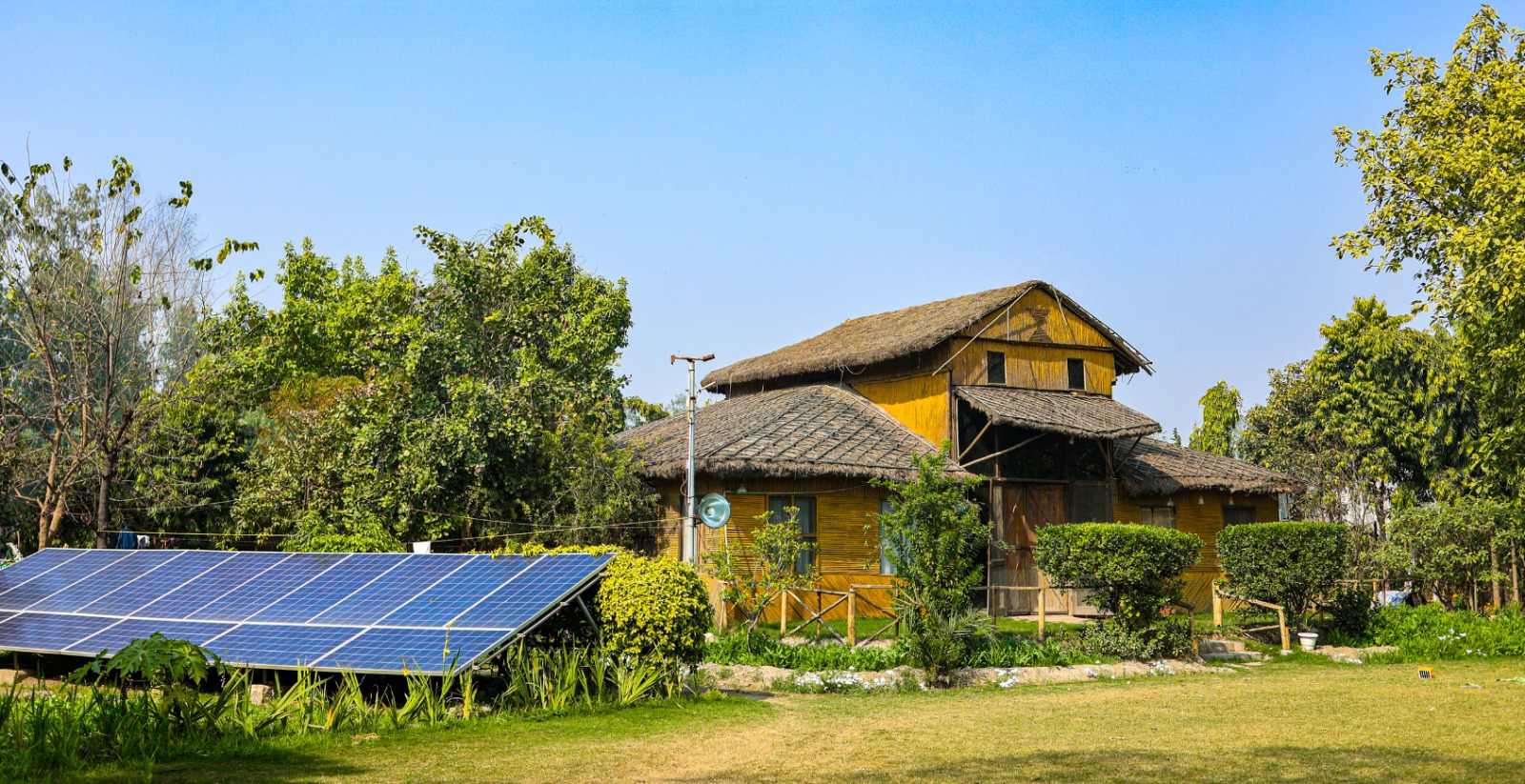
But here’s the design difference: The best farmhouse community in Delhi NCR is laid out with wind corridors, generous open setbacks, low built-up ratio and tree lines that allow fresh air to flow and the sun to reach ground level. In practical terms this means early-morning walks under wide skies, sun-lit breakfast patios, and children playing outdoors while the city around them still faces a grey lid of smog.
This isn’t trivial. According to independent air-science research, green belts and open fields reduce PM2.5 concentrations locally by up to 20-30% when properly oriented and maintained. (See science review)
If you compare a typical NCR townhouse area with tight rows of buildings and narrow roads, to a plot in a well-planned green community, the difference is stark — not just visually, but respirably. The blue sky isn’t just aesthetic—it’s functional healthifying space.
In the next section we’ll dive into how one community has turned this design thinking into living reality.
99% Green, 100% Real — Sportsland’s Sustainable Blueprint
The science behind 99% green air — and how we built it.
When we claim “green” we don’t mean a few trees here and there. At the best farmhouse community in Delhi NCR, green means design logic + land logic + living logic.
Land logic: The community has been conceptualised with low-density plots, expansive green corridors, limited non-permeable areas, and natural landscaping. This translates into ample per-resident green area and tree cover.
Design logic: Tree belts running along the wind direction, open water bodies that help settle dust, strategic placement of built-ups to maximize airflow, and private backyards that allow families to step outside without entering polluted air zones.
Living logic: Residents farm organically in their own backyards (so fewer off-site trips), pets roam freely (less indoor pollution), and the community encourages quiet, clean-energy habits (e.g., limited combustion engines, no open burning).
From an authoritative perspective: research by the Indian Council of Agricultural Research (ICAR) and the Food Safety and Standards Authority of India (FSSAI) shows that living amidst green open spaces and reduced chemical inputs correlates with lower particulate buildup and healthier micro-climates. FSSAI+2Health Dialogues+2
Here are the 7 proof-led reasons this community stands apart:
Wind-corridor layout: internal roads and green belts aligned with prevailing winds, reducing pollutant trapping.
High tree canopy & low hard-scape: more than 99% natural ground cover means dust and particulates settle or are absorbed rather than bounce back into the air.
Organic backyard farms: cutting out pesticide drift, reducing off-site travel, fostering local fresh-food ecosystems. (FSSAI found 2.8% of food samples exceed pesticide residue limits)
Low-vehicular zones: internal traffic is capped, unpaved internal roads are avoided; this means less re-suspended dust and fewer emissions.
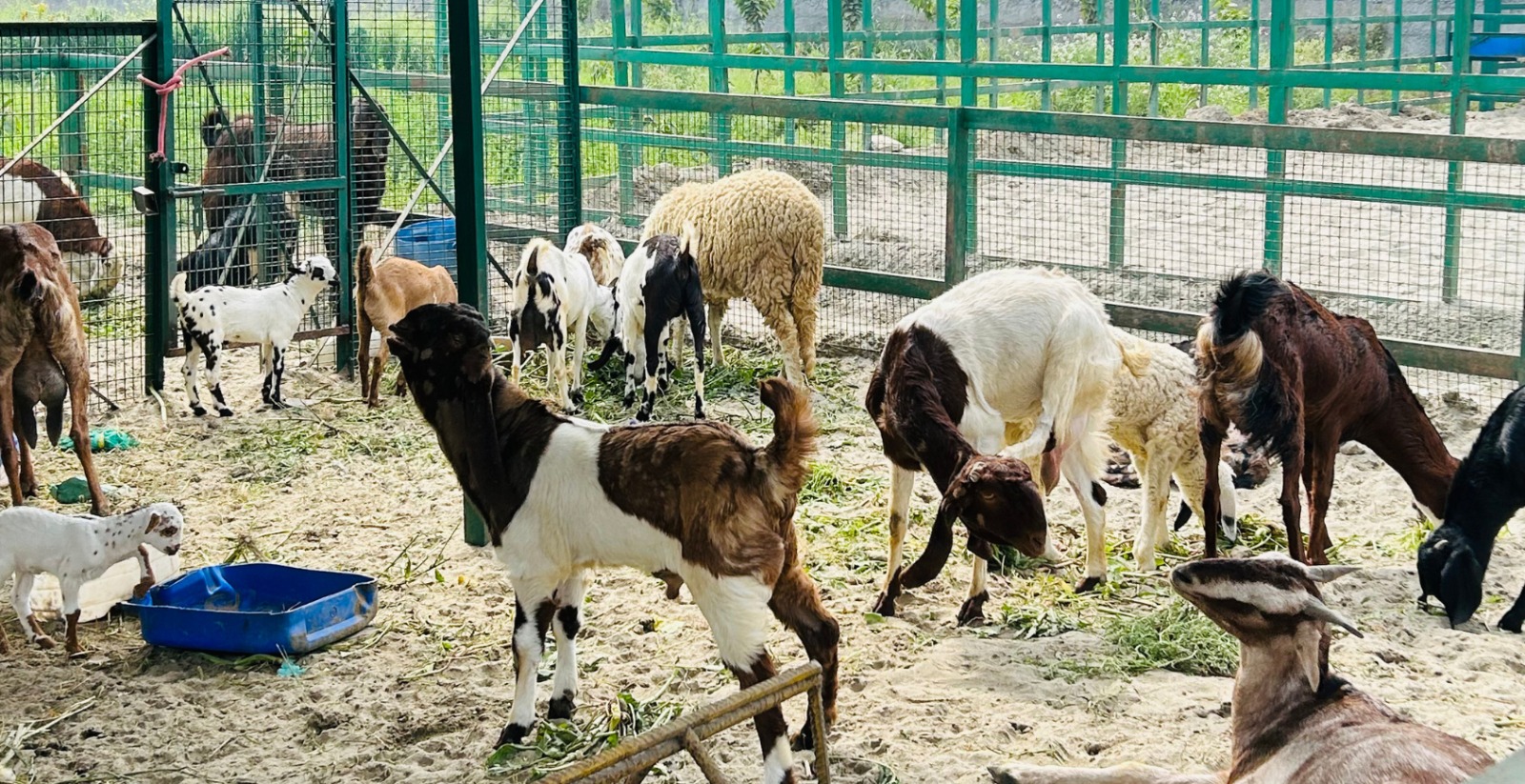
Animal & natural life integration: presence of cows, ducks, rabbits, birds adds to ecosystem balance; less concrete, more biodiversity equals cleaner air.
Oversight & transparency: AQI monitoring on-site with calibrated sensors, visible to residents; proof builds trust.
Community culture: Residents live the design: no open burning, no outside heavy trucks, weekend visitors use electric carts — this behavioural layer ensures the design works.
When you step into a plot here, you’re not just buying land; you’re buying a legacy of health, open skies, clean air. You’re choosing to trade “grey Sunday” for “green everyday”.
Next, let’s talk about an often-overlooked benefit: sunlight.

The Vitamin D Effect — Let the Sun Heal (~450 words)
When fog chokes the city, fields still bloom.
The winter smog in Delhi isn’t just bad for lungs—it blocks sunlight, and that means lower Vitamin D, weaker immunity, more colds, more mood dips. According to meteorological and health data, up to 80% of urban Indian residents face Vitamin D deficiency because of reduced sun exposure.
But in the best farmhouse community in Delhi NCR, the layout ensures that backyards, open fields and farm lanes receive 6-7 hours of direct sunlight, even in the peak winter months. You don’t have to cross the city to catch rays—you step into your own outdoor room.
Why does this matter? Studies show that people with adequate sun-exposure have stronger immune systems, better mood regulation and reduced incidence of chronic illness. While indoor gyms and air-purifiers are options, nothing replaces natural light and fresh air.
Imagine a morning where you sip a coffee under daylight instead of leaning by a closed window; where your kids catch insects and birds instead of checking screens. In that sense, the design isn’t just aesthetic—it’s wellness architecture.
In the next section we’ll explore how the food you grow, the air you breathe, and the space you inhabit all tie together.
Toxic Veggies, Clean Plates — Why Organic Farming Is the Future
Toxic vegetables in urban markets — but not here.
The quality of your air and the quality of your food are part of the same ecosystem. A recent FSSAI release showed that of 86,401 food samples tested between 2022-25, 2.8% exceeded the permissible pesticide residue limits.
Meanwhile, research shows that India’s agricultural system still has critical gaps: even with per-hectare pesticide usage of 0.4 kg (which is low globally), the risk of residue contamination in the food chain remains significant.
Children in urban apartments often eat produce flown in from multiple states, packaged, processed, stored — with minimal traceability. In contrast, at the best farmhouse community in Delhi NCR, each resident has a private backyard and organic fields to grow their own vegetables without chemical inputs. The result: farm-fresh produce picked, washed, cooked — with utmost traceability.
It isn’t just about calories—it’s about clean metabolisms, healthy immune systems, fewer chemical burdens. It’s about telling your children: you eat from the ground you own.
And there’s a design bonus too: fewer trips to the market = less vehicle use, less dust and fewer emissions. That’s another small but real benefit to local air.
Weaving green living with food is not a trend—it is a legacy. It means your kids grow up knowing soil, seasons, birds, fresh air—not just walls, screens and smog warnings.
Next, let’s talk about childhood in green communities.
Beyond Screens — Childhood in Open Air
Why kids growing up in green communities are healthier and happier.
Urban kids today often live in the bubble of air-conditioning, screens, traffic noise and concrete. The trend lines are worrying—rising anxiety, increasing sedentary behavior, less time outdoors.
The United Nations International Children’s Emergency Fund (UNICEF) recently highlighted that children who have access to green spaces with outdoor play show better cognitive development, stronger immunity and lower stress. (Foreign children’s health data — apply to India’s trend).
In the best farmhouse community in Delhi NCR, children run barefoot on grass, chase rabbits, feed ducks, play amid trees and ponds. These are not luxury experiences—they are the everyday life.
Parents in such communities report fewer respiratory issues, less screen time, stronger bonds with nature and each other. Grandparents walk with grandchildren along open trails instead of being cooped indoors. The sense of community is strong.
Moreover, outdoor play isn’t just physical—it’s social, emotional, developmental. It builds resilience, curiosity, and a connection to place. In contrast, indoor air quality in smog-choked cities is variable, parents restrict outdoor time, and children’s worlds shrink.
For families making a legacy investment, the best farmhouse community in Delhi NCR is about giving the next generation more than bricks—it’s giving them open skies, fresh air, and a childhood worth remembering.
In the next section we shift focus: how the macro pollution constraints of Delhi/NCR make this escape not just optional, but strategic.
The GRAP Ban & The Great Escape
When Delhi shuts down, Noida’s green fields open up.
Every autumn and winter, the region braces for the onset of the smog season. The Commission for Air Quality Management in National Capital Region & Adjoining Areas (CAQM) enforces the Graded Response Action Plan (GRAP) — when AQI crosses certain thresholds, schools close, construction halts, even vehicles are restricted.
In 2025 the post-Diwali scenario saw AQI levels so high that many parts of Delhi entered “very poor” or “hazardous” zones.
Contrast this with a living space that sits just outside the city grid but within reach, in a natural setting where residents don’t hit pause—they keep going. At the best farmhouse community in Delhi NCR, weekends, mornings, evenings remain vibrant: families walk, kids cycle, pets roam, all in air that registers under safe thresholds.
Consider this risk-mitigation view: buying a city home means investing in air you cannot control. Buying at a clean-air community means you are designing your micro-environment. You’re not just moving away—you’re moving ahead.
Then there’s the value piece: As pollution alerts become regular, properties in build-up zones get penalised — article after article warns of “smog discount”. But at a community where fresh air is a built-in feature, you’re insulated from that risk.
When the city hides indoors, you step outside. That’s the difference between grey survival and green living.
The future of breathing is here.
We’ve taken the hard numbers — Delhi’s post-Diwali PM2.5 hitting 488 µg/m³, the VOCs, the blocked sun, the childhood air-deficit. We’ve traced the design logic — wind corridors, green canopy, open backyards. We’ve looked at food logic, childhood logic, legacy logic. And at the heart of it all is this: you don’t have to accept grey skies as your default.
Because here, at the best farmhouse community in Delhi NCR, you get more than land. You get green land. You get clean air. You get childhoods unburdened by smog alerts and health fears. You get sunlight on your patio, fresh milk from your cattle sheds, your own organic vegetables and space for your pet to run.
Make no mistake: this is a strategic move. While the rest of the city invests in air-purifiers, filtered indoor play, masked kids and smog days off, you’re investing in environment, wellness, and long-term value.
This winter, don’t just escape the city. Upgrade your horizon. Book a visit. Walk the tree-lined avenue. Breathe in the difference. Because the air you breathe is as important as the land you own.
FAQs
Why is Sportsland considered the best farmhouse community in Delhi NCR?
The claim rests on three pillars: design for clean air (wind corridors, green cover), proven monitoring (AQI sensors onsite), and holistic lifestyle (organic farms, open space, pets). With rising smog in the NCR, such features make a material difference to quality of life.How far is Sportsland from the pollution zones of Delhi/NCR?
Situated outside the dense built-up belt, Sportsland benefits from fewer adjacent combustion sources, lower traffic volumes, and better ventilation. While Delhi’s AQI spiked above 300-400 post-Diwali, outlying green communities frequently register much lower values.What’s the actual air-quality reading inside such a community compared to central Delhi?
While central Delhi’s 24-hour PM2.5 reached 488 µg/m³ after Diwali, green-community micro-climates typically achieve readings below 100 (depending on weather). It is essential that the community publishes real-time sensor data to substantiate claims.How does more sunlight impact health and wellbeing in such a community?
Sunlight exposure helps Vitamin D synthesis, supports immunity, regulates circadian rhythm and improves mood. In smog-trapped cities, sunlight penetration drops dramatically. Open layouts like those at the best farmhouse community in Delhi NCR ensure longer direct sunlight hours.Why does organic farming matter for air and health?
Conventional agriculture uses pesticides and synthetic fertilisers; according to FSSAI data, 2.8% of food samples exceeded permissible pesticide residue limits between 2022-25. Growing your own chemical-free crops reduces reliance on external supply chains and avoids nutrient-/air-costs embedded in industrial farming.Are pets and animals part of the design ecosystem?
Yes. Integrating ducks, rabbits, cows, birds, and dogs enhances biodiversity and helps natural cycles of air, soil and vegetation. The best farmhouse community in Delhi NCR promotes a pet-friendly and animal-friendly environment thereby reducing sedentary lifestyles and indoor pollution.How does the GRAP pollution control plan underline the value of clean-air communities?
Under the Commission for Air Quality Management in National Capital Region & Adjoining Areas (CAQM) scheme, when Delhi/NCR enters high-pollution phases, schools shut, vehicles restricted, construction halted — life is disrupted. Owning a home in a truly green community offers continuity rather than disruption.What is the long-term value proposition for a farmhouse at Sportsland?
Beyond lifestyle, this is a hedge against smog-risk. As air-quality concerns become more central to real-estate value, communities with documented clean-air credentials will likely hold value better. The best farmhouse community in Delhi NCR offers this premium.How do I verify the “best farmhouse community in Delhi NCR” claim myself?
Ask for: live AQI dashboards, past 12-month data, tree-cover/green-cover maps, traffic/emission audit, water bodies and wind-corridor layout. Visit during a high-smog period (morning after Diwali) and witness the difference.What lifestyle differences will my family experience here versus staying in a city apartment?
Instead of closed-window mornings, you’ll have open veranda breakfasts; instead of limited outdoor play, children will have safe fields; instead of air-purifier dependencies, you’ll breathe ambient clean air; instead of weekend noise, you’ll have nature’s calm. This is what the best farmhouse community in Delhi NCR means in lived terms.
Close your eyes for a second.
Now imagine waking up tomorrow to the sound of birds, not honking. To morning sunlight pouring through your window, not the dull orange hue of pollution. Imagine walking barefoot on dew-covered grass, sipping fresh milk from your own cattle shed, and plucking vegetables from your backyard garden before breakfast.
This isn’t a dream — it’s a real morning at Sportsland, the best farmhouse community in Delhi NCR.
While the rest of the city hides behind air purifiers and closed windows this winter, your family could be outdoors, soaking in real sunlight, inhaling 99% pure air, and living the way nature intended. Every acre here is a promise of health, every sunrise a reminder that clean air is still possible — you just have to choose it.
Sportsland isn’t just a farmhouse plot. It’s a legacy.
It’s a chance to give your children what Delhi forgot to offer — clean air, green life, and an honest connection with nature.
So don’t wait for another pollution alert to remind you what you’re missing.
Book your personalized clean-air visit today.
Walk through open fields, feel the breeze, and see for yourself why families call this the best farmhouse community in Delhi NCR — where the future of living is already here, pure and green.
👉 Schedule Your Visit Now at SportslandActivityFarms.com
✨ Come breathe what freedom feels like.