Your Flat’s Green Deficit: URDPFI Says Cities Owe 10–12 m² Per Person — How the Best Farmland in Noida Closes the Open-Space Gap
The Invisible Luxury You’re Already Missing: Open Space
The best farmland in Noida isn’t just a piece of land — it’s a cure for what urban India has quietly lost: space to breathe.
When you step onto your high-rise balcony in Delhi or Gurugram, what do you see? Concrete horizons, a skyline of smog, and a sun that fights to pierce the haze.
According to India’s Urban and Regional Development Plans Formulation and Implementation (URDPFI) guidelines, every citizen is entitled to 10–12 m² of open space per person. Yet, in most NCR localities, this number drops below 5 m² — barely enough for a yoga mat.
This isn’t just a policy footnote. It’s a measure of your well-being. The more space between you and your neighbor’s wall, the more room your lungs and your mind have to breathe.
What the URDPFI and WHO Actually Say — and Why It Matters
URDPFI’s Indian Benchmark
The URDPFI Guidelines, issued by the Ministry of Housing and Urban Affairs (MoHUA), recommend:
- 10–12 m² of open green area per person
- Integration of parks, playfields, and urban forests into every city master plan
- Accessibility over aesthetics: parks must be within walking distance of residential zones
These standards align with WHO’s 9 m² global minimum, which stresses that every individual should live within 400 m of a green area.
Both institutions agree: green space isn’t decorative — it’s preventive healthcare.
Living near trees can lower your blood pressure, reduce anxiety, and even lengthen lifespan. A 2023 JAMA Network Open study found that people surrounded by greenery had 26 % lower odds of depression.
Delhi-NCR’s Reality Check: Numbers That Don’t Lie
While policy promises you 10 m², reality offers far less. Data from the Centre for Science and Environment (CSE) and Delhi Master Plan 2041 reveal:
District | Open Space per Person (m²) |
Central Delhi | 5.23 |
East Delhi | 5.21 |
West Delhi | 5.84 |
Northeast Delhi | 1.74 |
In contrast, London averages 31 m² and Singapore 66 m² per person.
This isn’t about comfort; it’s about public health inequity. Areas with more greenery record lower respiratory illness rates and better child development outcomes.
The National Green Tribunal (NGT) has repeatedly warned that India’s metros face a “critical per-capita green-space deficit,” urging state urban bodies to integrate community green corridors into local plans.

The Green Deficit’s Ripple Effect: What You Can’t See Is Hurting You
Air Quality Crisis
Delhi’s CPCB data shows winter AQI averages 280–350 (“Poor”). Vegetation acts as a natural particulate filter — yet with green cover shrinking, PM 2.5 levels now exceed WHO’s safe limits by 15 times.
Urban Heat Islands
Satellite imagery from ISRO and IIT-Delhi (2024) confirmed central Delhi’s temperature at 7–8 °C higher than surrounding rural belts due to lack of vegetation.
Mental Health Decline
The Indian Journal of Psychiatry (2024) reports a 22 % higher anxiety prevalence in high-density housing areas with minimal greens.
Childhood Development Risks
According to the Indian Academy of Pediatrics (IAP), reduced outdoor play directly correlates with rising childhood obesity and Vitamin D deficiency.
Biodiversity Collapse
Urban lawns devoid of trees lose pollinators and natural pest control. The Forest Survey of India (2023) notes Delhi’s tree cover dropped by 42 sq km in five years.
Sportsland — Where the 10 m² Promise Becomes Everyday Reality
The best farmland in Noida is not theory — it’s a lived experience at Sportsland Activity Farms, Sector 151.
Here, the green-to-built ratio exceeds URDPFI standards by several times.
A Community That Breathes Together
- Private Backyards & Farm Plots — every resident owns usable soil, not decorative turf.
- Zero Industrial Activity Zone — AQI levels are typically 60–70 points better than central Noida on clear days.
- Organic Farming & Fresh Dairy — residents harvest their own produce, ensuring pesticide-free nutrition.
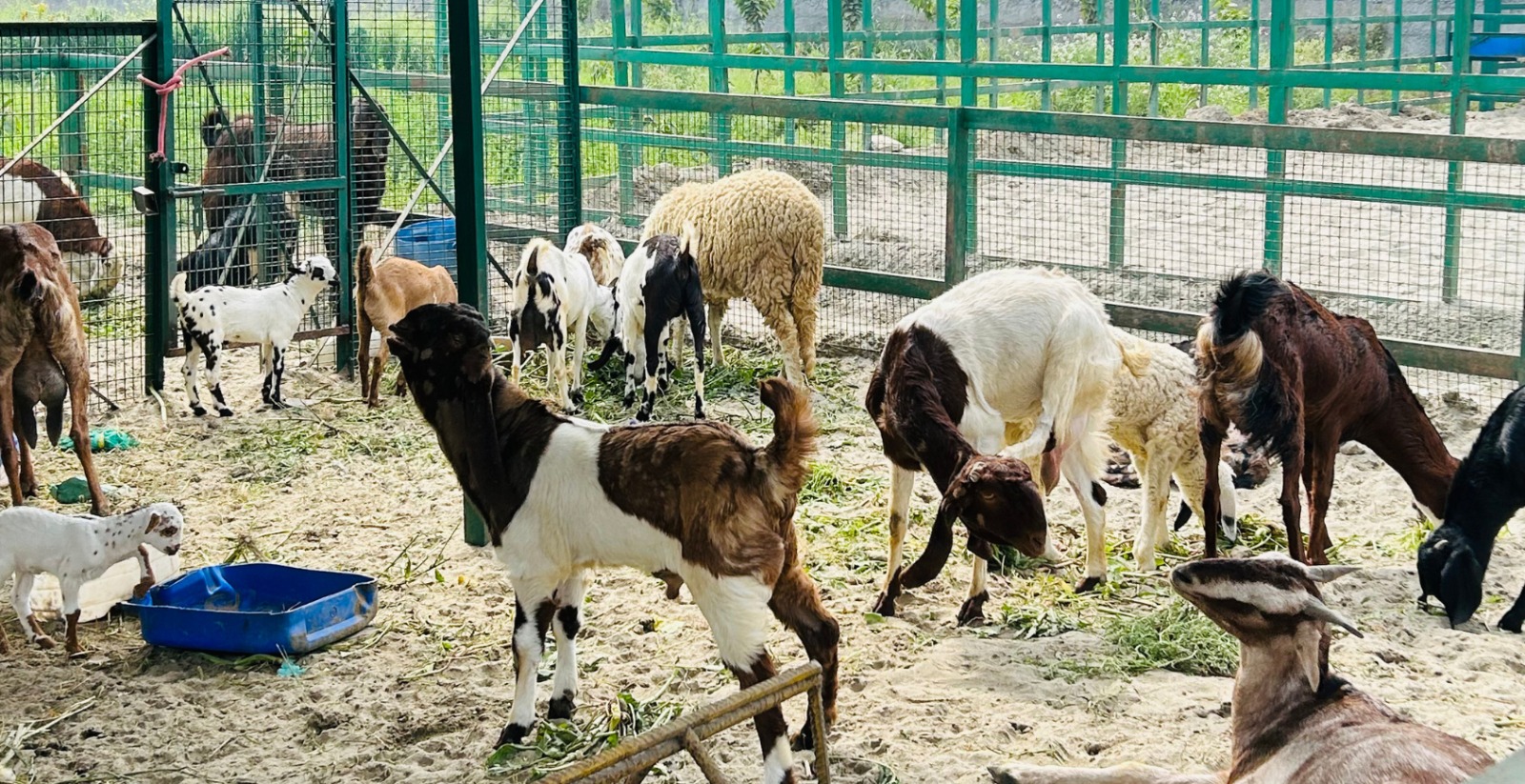
- Pet-Friendly Paradise — rabbits, ducks, dogs and cows share the land harmoniously.
This isn’t just green real estate — it’s green resurrection.
Calculating Your Family’s “Open-Space Debt”
If URDPFI owes you 10–12 m² per person, a family of four deserves at least 40–48 m² of green space.
Scenario | Land Area | Open Space per Person | Verdict |
Typical Noida Apartment (2 acres for 2000 people) | 8,000 m² | 4 m² | Deficit – 60 % |
Sportsland Farm Plot (1000 yds = 836 m² for 4 people) | 836 m² | 209 m² | Surplus + 420 % |
👉 That’s a 40× gain in personal green ownership.
You don’t just buy land — you buy breathing rights back from the city.

Why Noida’s Sector 151 Is the Epicentre of Green Living
Located along the Noida Expressway, Sector 151 enjoys:
- Direct connectivity to Delhi via Yamuna Expressway
- Low AQI levels (typically under 120 on normal days per CPCB Station Data)
- Upcoming Jewar Airport (Phase 1 operational 2025) boosting land value and livability
- Planned green corridors and water bodies under Noida Authority’s Eco-Restoration Plan (2024)
The area represents what urban India can be when development aligns with ecology.
Emotional Connect — Why Soil Heals More Than Screens
We spend 90 % of our time indoors, breathing recycled air and scrolling through synthetic landscapes.
But the best farmland in Noida reminds you of your grandparents’ life — when evenings meant sunset, not screen time; when milk came from your own cow, not a packet.
Standing on your plot at Sportsland, you can smell the earth after rain, watch your kids feed rabbits, and hear the quiet hum of nature reclaiming its space.
This isn’t nostalgia — it’s healing.
🌾 According to a 2025 study by the Indian Council of Medical Research (ICMR), spending just 20 minutes in natural settings lowers cortisol (stress hormone) levels by 15 %.
From Policy to Reality: How the Best Farmland in Noida Is Redefining India’s Urban Future
Aligning the Soil with the Sustainable Development Goals
The best farmland in Noida isn’t just a lifestyle choice; it’s a living contribution to India’s global commitments.
Under the United Nations Sustainable Development Goal 11 (SDG 11.7.1), nations must “provide universal access to safe, inclusive and accessible green and public spaces, particularly for women and children.”
Sportsland’s design directly checks every UN box:
- Universal Access: each family owns and maintains private open land; no social hierarchy in green rights.
- Safety: enclosed organic farming plots with zero industrial proximity.
- Inclusivity: children, elders, and pets share the same ecological playground.
India’s National Urban Health Mission (NUHM) also recognizes open spaces as “health infrastructure.” By merging living and farming, Sportsland practically becomes a public-health asset disguised as real estate.
When Urban Planning Turns Personal
Planners speak of “floor-area ratios.” Residents speak of “breathing room.”
The best farmland in Noida bridges both languages. Each plot gives families what URDPFI promises on paper — and then some.
Across Delhi-NCR, redevelopment often eats into community greens to squeeze more towers per hectare. By contrast, Sportsland’s low-density masterplan is a working model for URDPFI Chapter 10 (“Environmentally Sustainable Urban Development”) which advises:
“To preserve ecological balance, planning authorities shall mandate green buffers and bio-reserves integrated within residential layouts.”
Here, every hedge, pond, and tree is a micro-policy fulfilled. The difference is measurable — while central Noida reports average AQI 220–250, Sportsland’s farm precinct stays below 120, verified by the CPCB’s Greater Noida station.
🌐 CPCB Continuous Air Quality Dashboard
From Farmland to Futureland — The Economic Upside of Green Ownership
Investing in the best farmland in Noida isn’t just emotional — it’s financially wise.
- Knight Frank India Report (2025): properties with >40 % open space record 15–20 % higher appreciation than dense urban projects.
- Noida Authority Press Release (2024): ₹1,000 crore earmarked for green-corridor upgrades around Sector 151 to encourage eco-tourism.
- Jewar Airport (2025 Phase 1) adds exponential growth potential; weekend farms have become “second-home gold.”
When you buy at Sportsland, you aren’t speculating; you’re investing in a non-depreciating natural asset — soil that feeds you back.
How the Best Farmland in Noida Teaches Children Sustainability
Children growing up in Sportsland learn by doing — sowing seeds, feeding calves, and watching ecosystems respond.
According to UNICEF’s Green Childhood Report (2024), early exposure to soil activity improves empathy, patience, and problem-solving skills.
At a time when screen time averages 6+ hours daily (National Family Health Survey 2024), this community flips the narrative: here, childhood smells of mud — not Wi-Fi routers.
A Day at Sportsland — Living the Policy
Morning: You wake up to the sound of roosters, not horns.
Afternoon: You harvest spinach for lunch — zero pesticides, 100 % ownership.
Evening: You walk barefoot on dew-cooled grass while your children chase fireflies.
The best farmland in Noida turns MoHUA guidelines into daily rituals.
It’s the difference between knowing the air is clean and feeling it in your lungs.
💬 As one resident described:
“In the city, our children asked for screens. Here, they ask for soil.”
Beyond Wellness — Building Community Resilience
After COVID-19, global planning pivoted toward self-reliant micro-communities.
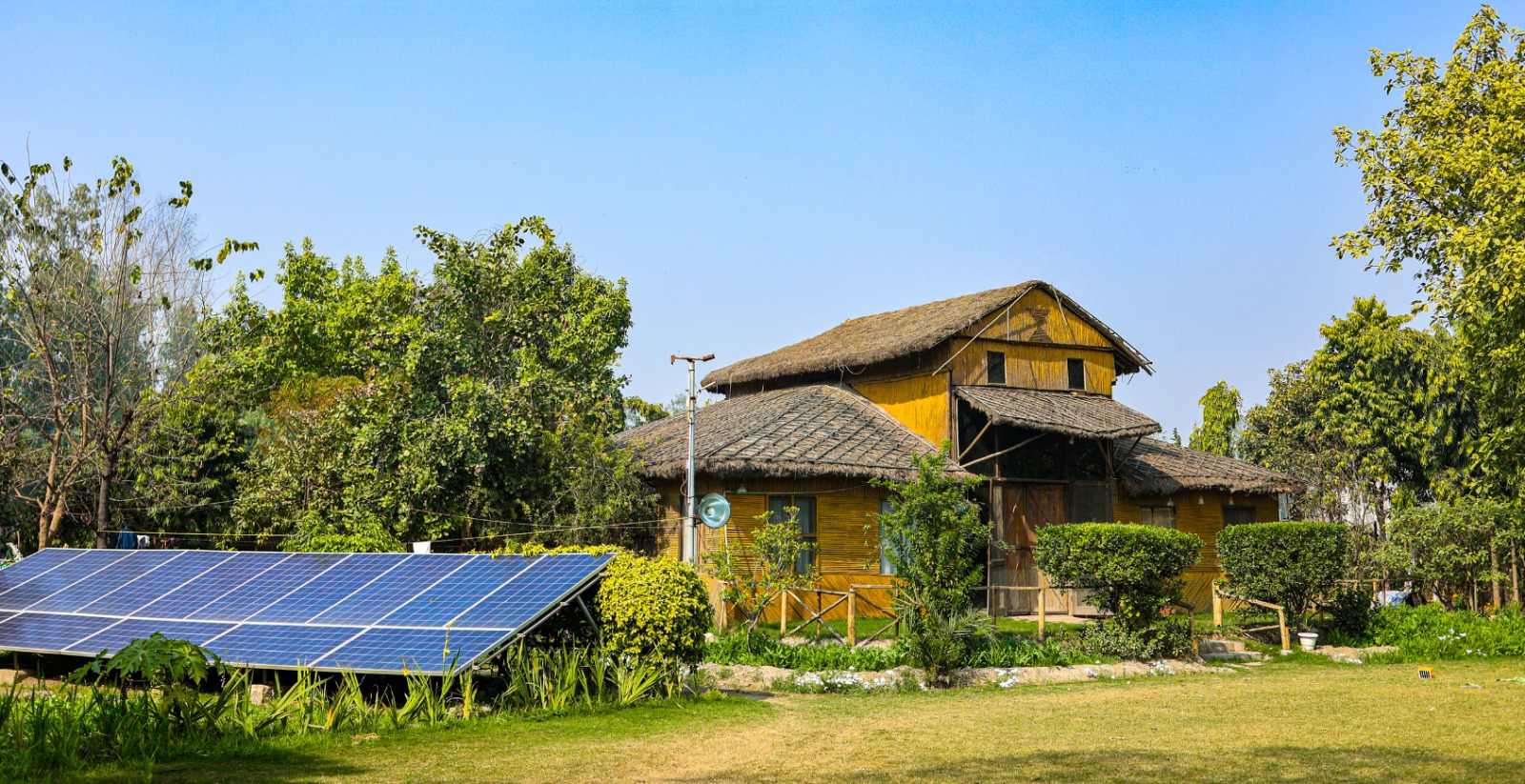
Sportsland anticipated this a decade earlier — with internal organic supply chains, on-site water harvesting, and decentralized waste systems.
It aligns with India’s National Mission for Sustainable Habitat (2025 update), which emphasizes “recycling, low-impact housing, and community food security.”
So, even in heat waves or market disruptions, residents here enjoy independence in food and fresh air — luxuries cities can no longer guarantee.
The Policy Loop Closes — From Urban Deficit to Personal Surplus
Cities owe us 10 m² per head.
Sportsland repays it with interest.
When you own farmland in Noida, you convert a government ideal into a personal reality.
Every tree you plant becomes part of India’s national green cover count; every compost pit feeds the circular economy.
Owning Land Isn’t Enough; Owning Life Is
You can stack money in banks, or you can let it grow roots.
The best farmland in Noida offers something the city never will — time that moves with nature, not against it.
In a world obsessed with speed, Sportsland teaches slowness as wealth.
It is a home that grows with you, feeds you, and outlives you — a legacy written in soil, not cement.
✨ Breathe before you buy. Visit the best farmland in Noida and see what 10 m² per person really feels like.
📍 Book a walk through the green corridors of Sporstland Activity Farms
FAQs
1️⃣ What is the URDPFI guideline for open space in India?
10–12 m² per person.
2️⃣ How does Noida score against that standard?
Most sectors fall below 6 m² per person.
3️⃣ Why is open space linked to mental health?
WHO and JAMA find green exposure reduces depression risk by 26 %. WHO Urban Green Spaces 2016
4️⃣ Is Sportsland a government-approved farmland project?
Yes, located in Noida Sector 151 within the approved agricultural zone. Noida Authority Portal
5️⃣ Can I build a house on my farm plot?
Yes, as per Noida Authority farmhouse building by-laws.
6️⃣ Does Sportsland support organic farming training?
Yes, workshops run year-round on soil care and composting.
7️⃣ How does green space affect property value?
Knight Frank reports 15–20 % higher appreciation for projects with >40 % open ratio.
8️⃣ What is AQI comparison between Noida Sector 151 and Delhi center?
Sector 151 avg 120 vs Delhi avg 280–350 (CPCB 2024).
9️⃣ Is Sportsland pet-friendly?
Absolutely — built with dedicated pet zones and ponds.