Delhi NCR Air Pollution 2025: The Smog Is Back—Here’s Why Families Are Choosing Sportsland’s Greener, Kid-Safe Life Near Noida
Delhi wakes under a toxic sky—your children don’t have to
By the time Delhi’s buses hit their first stop, the city is already breathing hard. Delhi NCR air pollution climbs before sunrise, dips a little by late morning, then clings to the skyline as the day cools—turning childhood into an indoor season. On 6 November 2025, the citywide AQI hovered around “Poor” to “Very Poor” (CPCB 9am snapshot ~228), with NCR pockets swinging worse; Gurgaon’s average was flagged as one of the day’s most toxic clusters. The pattern is familiar, the stakes are not: it’s your kids’ lungs, routines, and joy on the line.
But a few minutes off the main highway is a different daily reality: Sportsland Activity Farms—a nature-first community where green buffers, private backyards, organic farming, and pet-friendly spaces lower exposure and put kids back outside more days in a year. When Delhi NCR air pollution turns cities into walled gardens, Sportsland turns gardens into childhood.
The situation right now: numbers, stages, and why it keeps swinging
- AQI seesaw: Over the last few days, Delhi has oscillated from Severe spikes back to Poor/Very Poor—a whiplash that keeps parents glued to apps. On 5–6 November, CPCB dashboards showed overall city AQI around 228–245 (Poor) after a recent Severe spell that touched ~375 at its worst last week. Gurgaon clusters remained among the day’s hot spots.
- Government response (GRAP): The Commission for Air Quality Management (CAQM) has invoked GRAP Stage-II in October 2025 (AQI 301–400) with curbs on dust, construction, and dirtier vehicles—part of a graduated playbook that scales up to Stage-III/IV if conditions deteriorate. Commission for Air Quality Management
- Public advisories (SAFAR): Forecasts continue to caution sensitive groups to avoid exertion outdoors; all citizens are advised to skip early morning and post-sunset outdoor activity during high-AQI windows. SAFAR
- Global health yardstick: The WHO 2021 Air Quality Guidelines recommend a PM2.5 annual mean ≤5 µg/m³ (with NO₂ ≤10 µg/m³)—levels far below NCR’s winter reality. World Health Organization+1
Bottom line for parents today: Delhi NCR air pollution is volatile across hours and neighborhoods. Your best lever is daily exposure, not just city averages. Micro-environments matter.
Why this hurts children disproportionately
- Smaller airways, deeper penetration: Fine particulate matter (PM2.5) reaches deeper into children’s lungs; the same hour of exposure is costlier for a 6-year-old than a healthy adult. Align your routines to lower-AQI windows. World Health Organization
- Long-term risk is real: 2025 AQLI analysis estimates Delhi residents lose ~8.2 years of life expectancy at current PM2.5 levels—one of the starkest signals in the world. AQLI
- From play to screens: When Delhi NCR air pollution forces kids indoors for days, they swap sunlight and movement for blue-light and sedentary time, hampering sleep, mood, and resilience.
Exposure beats gadgets: how green design changes the math
Purifiers and N95s are essential—but they don’t create safe outdoor time. The lever that changes your child’s daily life is the micro-environment:
- Tree belts & hedges that intercept coarse dust and slow gusts.
- Permeable soils & mulched beds that cut re-suspended dust.
- Setbacks & low-traffic internal streets to limit tailpipe exposure.
- Backyard-first access so kids step into green within seconds—no car parks, no signal crossings.
Sportsland has been planned around these realities—so even when Delhi NCR air pollution dominates headlines, your children spend more of the week outdoors.
What “daily green” looks like at Sportsland
- Private backyards for every resident—plant, water, harvest, repeat.
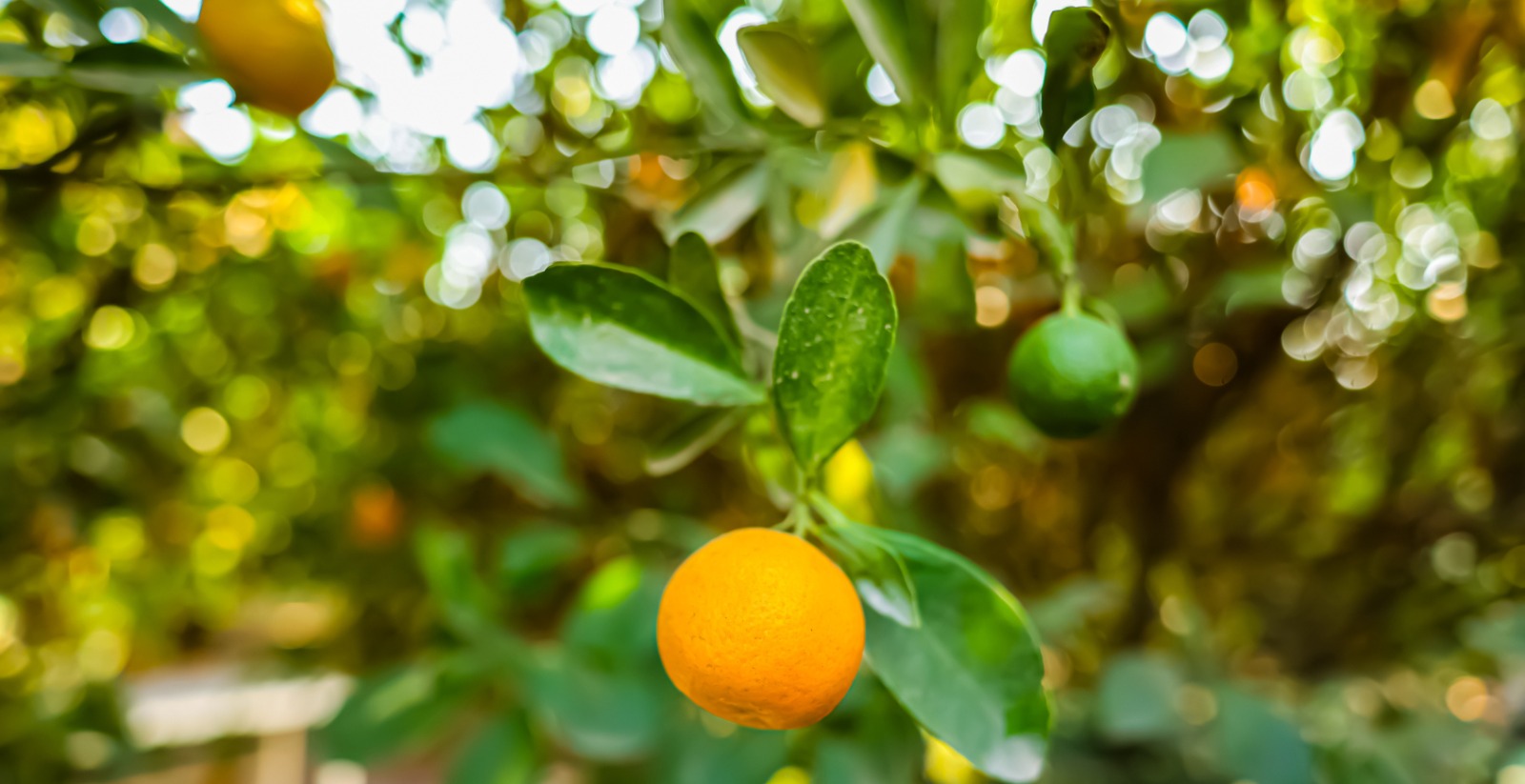
- Organic farming culture—kids learn seasons, not just screens.
- Pet-friendly habitat (dogs, rabbits, turtles, ducks) that pulls families outdoors.
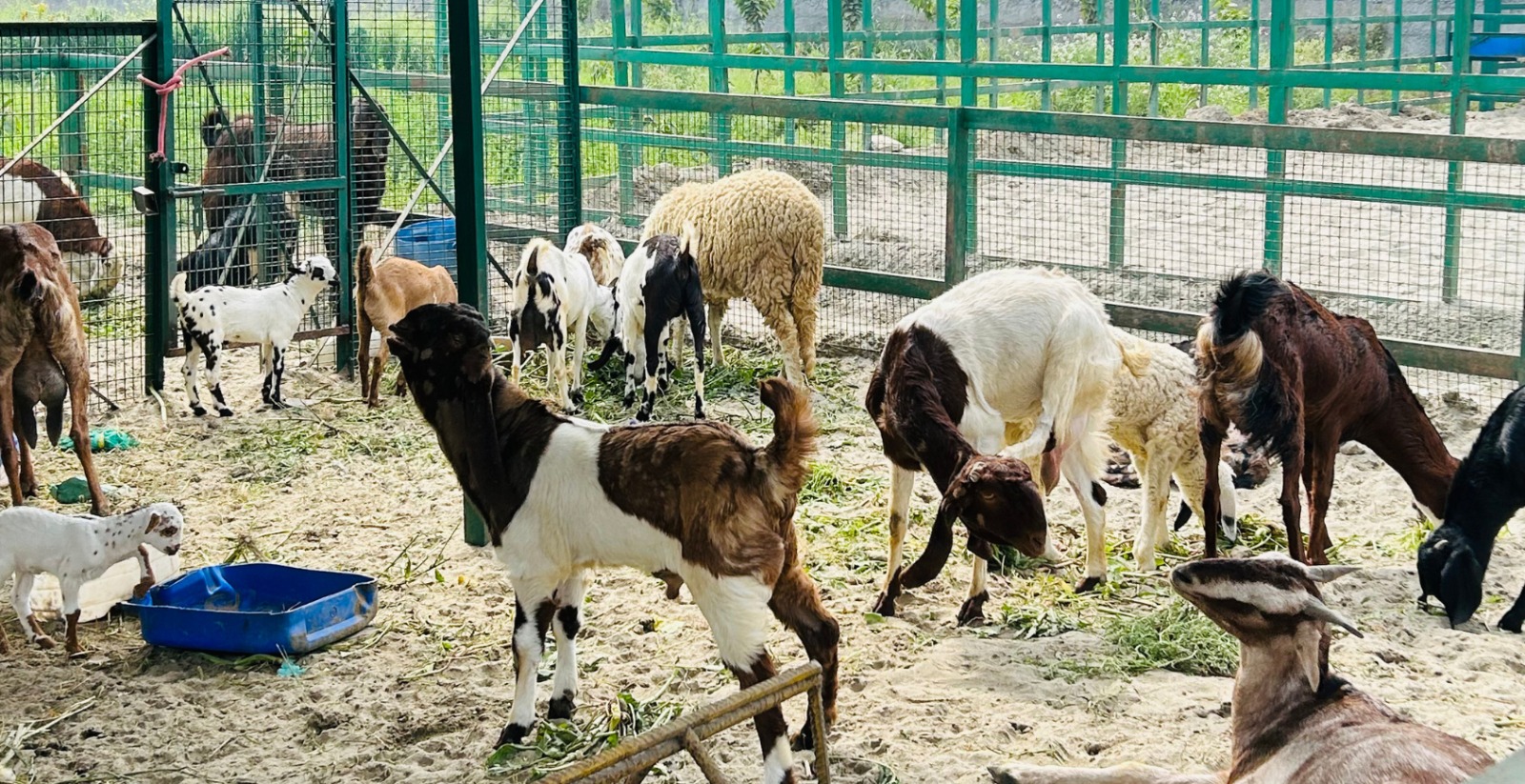
- Farm-to-table rhythm (including community milk from on-site sheds).
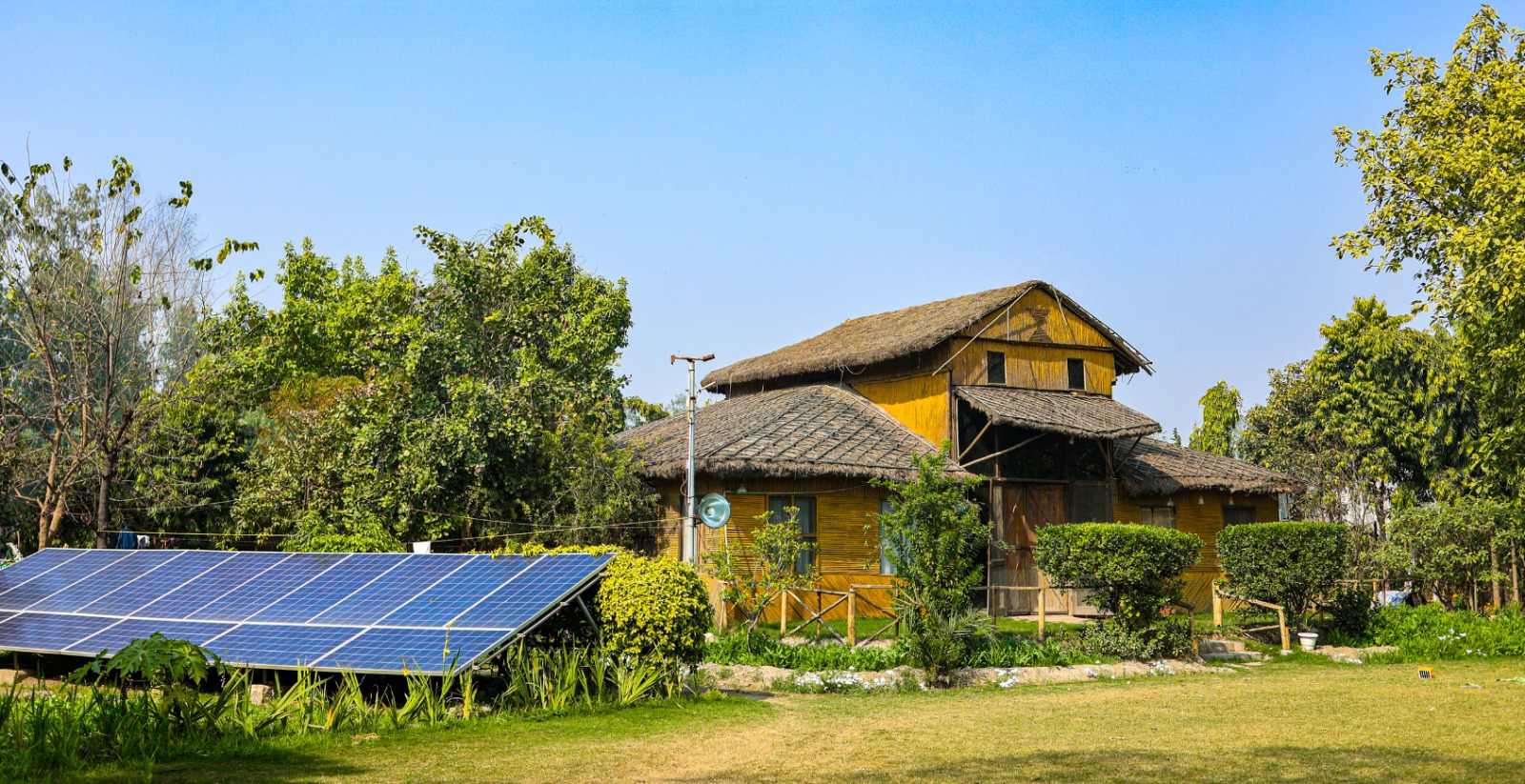
- Green massing that softens dust and heat while opening sightlines to sky.
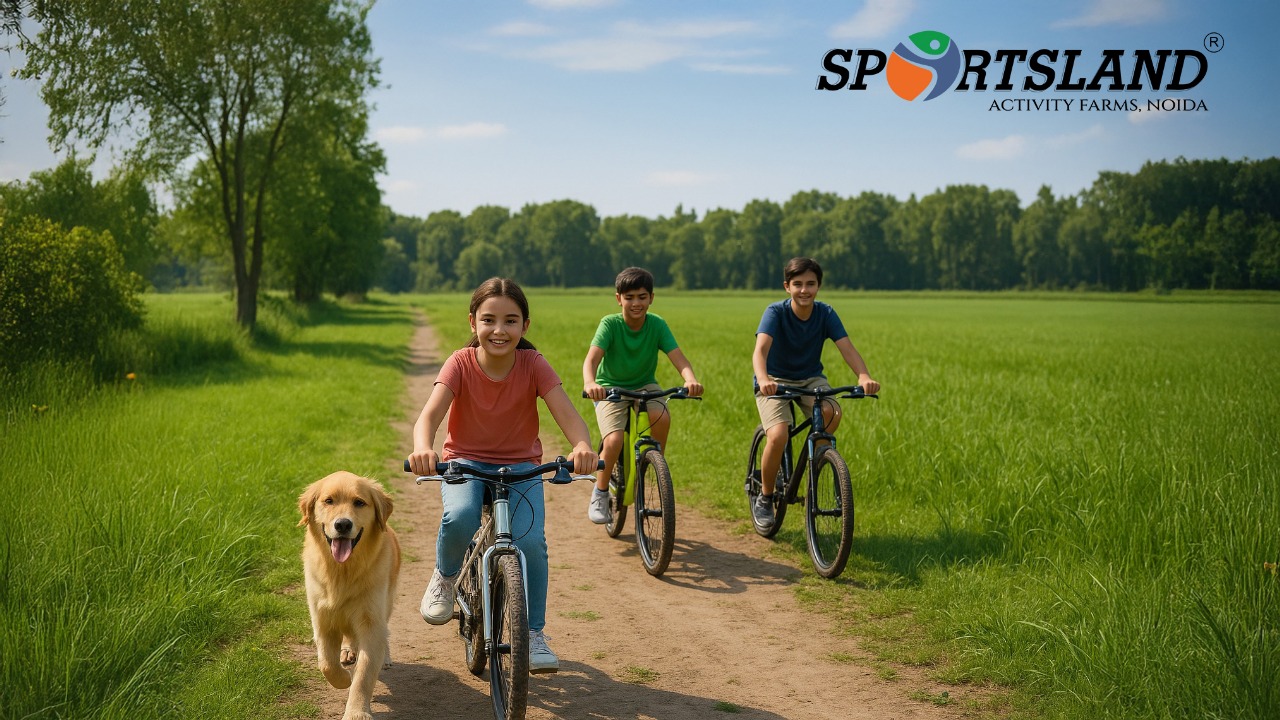
Families don’t “escape” to Sportsland once a month—they live there: fewer AQI-induced cancellations, more evening cycles, and better sleep after real play.
“But isn’t all of NCR affected?”—Yes… and design still decides your day
Regional smog is a blanket; exposure is a spotlight. Two families can sit under the same forecast for Delhi NCR air pollution, but the one surrounded by trees, permeable soils, and low internal traffic gets more safe outdoor minutes and fewer emergency indoor days—week after week. That’s the compounding effect of design.
A realistic week when Delhi NCR air pollution is peaking
Monday: Water the winter greens before school; short backyard walk for the dog.
Tuesday: Math homework on the patio; sunset play on a green lane (skip early-morning smog). SAFAR
Wednesday: Science in the soil—worm counts, soil moisture, leaf journals.
Thursday: Yoga on the lawn; parents log deep-work hours outdoors.
Friday: Wheelbarrow races; early bedtime without screens.
Weekend: Zero “Where can we go?” panic. Your outing is home: shade, pets, harvest, stars.

What the data and policy say (quick snapshots to reference)
- City AQI ~228 at 9 am (Nov 5–6); still Poor despite slight improvement. The Times of India+1
- Earlier “Severe” spikes (~375) last week, with mixed neighborhood levels across the city. The Economic Times
- Gurgaon flagged as most toxic cluster today (averages around 225 with several hot spots). Navbharat Times+1
- GRAP-II in force (Oct 19, 2025 order)—curbs escalated as needed. Commission for Air Quality Management
- SAFAR advisory—avoid outdoor exertion during high-AQI windows. SAFAR
- WHO 2021 guidelines—PM2.5 ≤5 µg/m³ annual; NO₂ ≤10 µg/m³ annual. ERS – European Respiratory Society
- AQLI 2025—Delhi residents lose ~8.2 years at current PM2.5 levels. AQLI
Parents’ playbook for smog season (Sportsland edition)
- Check CPCB/SAFAR twice daily and time play for relatively cleaner windows (late morning / mid-afternoon). Central Pollution Control Board+1
- Keep N95s handy for errands and rides on Poor–Severe days.
- Rotate “nature jobs”—watering, mulching, pruning, compost turns, pet walks.
- Short outdoor bursts rather than one big session on iffy days.
- Blue-light cutoff 60–90 minutes before bed; green fatigue > screen fatigue.
- Follow GRAP advisories from CAQM; cooperate with construction/vehicle curbs. Commission for Air Quality Management
Why this isn’t a one-season problem (and how the world is reacting)
Delhi’s winter inversion will return next year; so will emissions. Globally, regulators are tightening limits: the EU has agreed on stricter PM2.5 and NO₂ standards by 2030 (PM2.5 10 µg/m³; NO₂ 20 µg/m³), still above WHO 2021 but a step closer. That tells you where policy is heading—and why exposure-smart living will only gain value. Reuters+1
Sportsland vs. the city grind (at a glance)
Reality | Central Delhi/Hot-spot Corridors | Sportsland Micro-Environment |
AQI pattern | Frequent Very Poor/Severe pockets; long commutes to clean space | Lower exposure via green massing, setbacks, low internal traffic |
Outdoor play | Cancelled or masked; screens win | Backyard-first; short, frequent play windows |
Weekend plan | “Where can we go?” searches | Gardens, pets, harvests—at home |
Stress | High planning load around AQI | Predictable, nature-anchored routines |
Legacy | Yearly smog seasons | Daily green habits kids will remember |
(Note: Sportsland doesn’t control regional AQI; it reduces your personal exposure through community design.)
10 SEO-ready FAQs about Delhi NCR air pollution (with fresh references)
Q1) What is the current status of Delhi NCR air pollution this week?
A. City AQI has sat around the Poor band (~228 at 9 am on Nov 5–6) with recent “Severe” spikes earlier; Gurgaon clusters flagged among the worst today. Always check CPCB’s latest before planning. The Times of India
Q2) What do GRAP stages mean for my family’s routine?
A. GRAP scales from Stage-I (Poor) to Stage-IV (Severe+) with tightening curbs (dust, construction, vehicles). Stage-II is active this season; schools and offices may alter routines if stages escalate. Commission for Air Quality Management
Q3) Should kids avoid all outdoor activity during Delhi NCR air pollution peaks?
A. Follow SAFAR guidance: avoid outdoor exertion during high-AQI windows, especially for sensitive groups. Time short play bursts to relatively cleaner hours. SAFAR
Q4) What’s the global “safe” benchmark for PM2.5?
A. WHO 2021 recommends ≤5 µg/m³ annual PM2.5 and ≤10 µg/m³ NO₂—far below typical NCR winters. ERS – European Respiratory Society
Q5) How much life expectancy does Delhi NCR air pollution cost?
A. AQLI 2025 estimates ~8.2 years lost in Delhi at current PM2.5, underscoring why exposure-smart living matters. AQLI
Q6) Do masks and purifiers “solve” the problem?
A. They’re essential layers—but they don’t create safe outdoor time. The lever is your micro-environment (trees, soils, setbacks, car-light interiors).
Q7) Why consider a green community inside NCR instead of moving far away?
A. Proximity + design. Sportsland keeps work/school routes viable while lowering daily exposure and restoring outdoor time—practically, not hypothetically.
Q8) Do schools actually shift online when it gets really bad?
A. Yes, authorities have moved classes online during Stage-IV/Severe periods in recent seasons; headlines last winter documented city-wide online shifts. Hindustan Time.
Q9) Is the rest of the world tightening standards too?
A. The EU has agreed to strengthen air-quality limits by 2030 (PM2.5 10, NO₂ 20 µg/m³), narrowing the gap with WHO guidelines.
Q10) What’s the single clearest reason families choose Sportsland during smog season?
A. Consistency. More safe minutes outside, most days of the week—because design turns “AQI anxiety” into daily green.
Breathe different this winter. Book a discovery walk at Sportsland Activity Farms (Noida) and see how private backyards, tree belts, and open skies turn Delhi NCR air pollution into daily green for your kids.
Bring back outdoor childhood—every day. Plan your weekend visit to Sportsland: harvest a salad, walk the dog, and watch screens lose to sunshine.