2026 Wake-Up Call: Why Farm Community Living in NCR Is Becoming a Strategic Lifestyle Decision
For decades, Delhi–NCR symbolised ambition. It was the geography of power, policy, enterprise, and upward mobility. Professionals moved in, institutions expanded, infrastructure accelerated, and wealth concentrated. But as NCR evolved into one of India’s most influential economic regions, it also accumulated pressures that are now impossible to ignore.
By 2026, a noticeable shift is underway.
Residential decisions are no longer driven solely by location, price, or prestige. Increasingly, they are driven by health exposure, environmental quality, daily lifestyle design, and long-term sustainability. This shift explains why farm community living in NCR has moved from a niche curiosity to a serious, researched, and deliberate lifestyle choice among mature buyers, NRIs, policymakers, and investors.
This blog explores why.
Not as a promotional narrative.
Not as a trend piece.
But as a deeply researched, fact-based examination of why farm community living in NCR is emerging as a rational response to the realities of modern urban life.
NCR’s Growth Story and the Hidden Cost of Urban Density
Delhi–NCR has experienced one of the fastest urban expansions in South Asia. Roads widened, expressways multiplied, commercial corridors grew vertically, and residential towers filled the skyline. This development supported economic growth—but it also introduced invisible costs.
Air quality as a structural concern, not a seasonal one
India’s air quality is monitored by the Central Pollution Control Board (CPCB) through a nationwide network of stations. The presence of such a comprehensive system reflects the seriousness of the issue.
Residents can track real-time and historical air quality data across NCR using official government platforms.
These are not media interpretations; they are primary government data sources.
Globally, the World Health Organisation (WHO) has confirmed that 99% of the world’s population breathes air exceeding WHO guideline limits, significantly increasing health risks.
For NCR residents, this shifts the conversation from inconvenience to chronic exposure.
Pollution and long-term health outcomes
The State of Global Air report—one of the most widely cited global health references—establishes strong associations between long-term exposure to fine particulate matter (PM2.5) and serious health outcomes, including:
- cardiovascular disease
- stroke
- lung cancer
- chronic respiratory illness
- type-2 diabetes
Health risk from pollution is not immediate or dramatic—it is cumulative. And cumulative risk changes how people evaluate where they live.
This is a foundational reason why farm community living in NCR is gaining attention among informed buyers.
Understanding Farm Community Living NCR Beyond the Buzzword
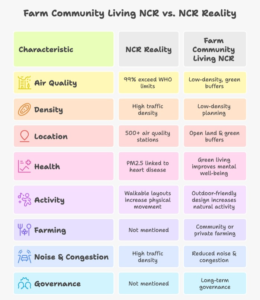
The term farm community living NCR is often misunderstood or oversimplified. It does not refer to isolated farmland or unregulated farmhouse plots. At its core, it represents planned, low-density residential ecosystems designed around environmental balance and human well-being.
True farm community living in NCR typically includes:
- controlled development density
- substantial green cover and open land
- minimal traffic congestion
- walkable layouts
- private or community farming zones
- pet-friendly environments
- long-term governance and maintenance systems
The defining principle is environmental continuity—how air flows, how people move, how noise dissipates, and how daily routines unfold.
Unlike high-density urban housing, farm community living in NCR prioritises quality of life metrics, not just square footage.
Why 2026 Marked a Behavioural Shift
Preventive health has become a lifestyle strategy
Healthcare conversations among mature professionals and families have evolved. Health is no longer seen as something managed only through hospitals and interventions—it is increasingly managed through daily exposure control.
Questions people now ask before buying a home include:
- How much time will I spend outdoors daily?
- What is the traffic density around my residence?
- How much green cover exists within walking distance?
- Is physical movement built into daily life?
Farm community living in NCR addresses these questions structurally, not aspirationally.
Mental health and cognitive recovery matter more than ever
High-pressure professional environments create sustained cognitive load. Research increasingly suggests that access to green spaces is associated with better mental health outcomes and stress recovery.
A large-scale study published in The Lancet Planetary Health highlights associations between greener living environments and improved mental well-being.
While no environment eliminates stress, farm community living in NCR supports psychological recovery, a factor now central to residential decision-making.
Air Quality, Location, and What Can Actually Be Controlled
It is important to be precise: no residential development can eliminate regional air pollution. However, local conditions can significantly influence daily exposure.
Factors that affect local air quality include:
- proximity to high-traffic corridors
- industrial activity
- construction density
- green cover
- wind corridors and open land
Government monitoring systems exist precisely to track these variations. Informed buyers researching farm community living in NCR increasingly rely on CPCB dashboards to compare regions over time.
This reflects a mature shift from idealism to risk reduction.
Green Spaces: Functional Infrastructure, Not Decoration
One of the most persistent misconceptions about farm community living in NCR is that greenery is primarily aesthetic. In reality, green spaces perform essential functions.
Research reviews have shown associations between exposure to green spaces and improved physical and mental health outcomes.
Green infrastructure influences:
- daily movement patterns
- social interaction
- noise reduction
- micro-climate moderation
- psychological comfort
In a farm community living in NCR, green space is infrastructure, not ornamentation.
The Role of Farming and Food Security in Residential Choices
Food quality has become a central concern for many households—not driven by trends, but by trust.
Farm community living in NCR often integrates:
- kitchen gardens
- community farming plots
- organic or chemical-reduced cultivation
- composting and soil management
Participation in food production—however limited—has measurable psychological benefits. It fosters routine, engagement, and a sense of control over daily consumption.
For senior residents, farming activities offer purpose and physical engagement.
For families, they provide experiential learning.
For professionals, they act as grounding mechanisms.
Water Management: The Most Overlooked Critical Factor
Among sophisticated buyers, water planning is often more important than design aesthetics.
Sustainable farm community living in NCR must demonstrate:
- rainwater harvesting systems
- groundwater recharge planning
- efficient irrigation practices
- long-term water sustainability models
Water resilience determines whether a community remains viable over decades. It is a non-negotiable for long-term planners and investors.
Density, Governance, and Long-Term Stability
The success of farm community living in NCR depends heavily on discipline.
Density control
Low density preserves every promised benefit—from air movement to privacy. Overdevelopment erodes the core value proposition.
Governance
Transparent governance structures ensure:
- maintenance quality
- enforcement of planning norms
- long-term environmental integrity
These factors separate enduring communities from speculative developments.
Who Is Choosing Farm Community Living NCR Today?
Senior professionals and policymakers
Individuals operating under sustained pressure prioritise environments that support recovery and longevity.
NRIs planning long-term Indian roots
Farm community living in NCR offers a globally comparable residential experience grounded in land ownership.
Families planning intergenerational assets
Unlike high-rise housing, land-centric living retains adaptability across generations.
Investors seeking stability
Low-density residential land behaves differently from speculative housing markets, offering resilience over cycles.
Investment Perspective: Stability Over Volatility
While this is not an investment advisory, it is worth noting that farm community living in NCR typically aligns with:
- lower volatility
- intrinsic utility
- lifestyle-driven demand
For investors focused on preservation and long-term value, these characteristics matter.
Alignment With National and Global Sustainability Goals
The rise of farm community living in NCR aligns with India’s broader sustainability objectives, particularly:
- SDG-3: Good Health and Well-Being
- SDG-11: Sustainable Cities and Communities
Residential choices increasingly reflect these macro-level priorities.
Common Misconceptions Clarified
“It’s only for weekends.”
Many farm communities now support full-time living with modern infrastructure.
“It’s isolated.”
Strategic planning balances connectivity with environmental buffers.
“It’s only lifestyle-driven.”
Lifestyle is now recognised as a serious determinant of long-term health and productivity.
Why This Is Not a Passing Trend
Trends fade. Structural shifts endure.
The forces driving farm community living NCR—urban density, health science, demographic ageing, and lifestyle recalibration—are cumulative and irreversible.
As NCR continues to grow, the relative value of space, air, and nature-integrated living is unlikely to diminish.
FAQ
1. What is farm community living in NCR, and how is it different from regular farmhouse ownership?
Farm community living NCR refers to a planned, low-density residential ecosystem built around open land, green cover, and nature-integrated living—unlike isolated or unregulated farmhouse plots.
The key difference lies in planning and governance. Farm community living in NCR typically includes:
- controlled density
- shared infrastructure
- long-term maintenance systems
- community farming or organic cultivation
- walkable layouts and environmental buffers
Unlike standalone farmhouses, these communities are designed for sustained, full-time livability, not just weekend use. This structured approach is why farm community living in NCR is increasingly preferred by long-term planners and investors.
2. Why is the farm community living in NCR gaining attention specifically after 2025–26?
The rise of farm community living in NCR coincides with a broader awareness of environment-linked health risks and lifestyle sustainability.
According to the World Health Organisation, 99% of the global population breathes air exceeding recommended quality limits, increasing long-term health risks.
As NCR residents become more aware of cumulative exposure—rather than short-term pollution spikes—many are reassessing where and how they live. Farm community living in NCR offers a way to reduce daily exposure intensity while improving lifestyle quality.
3. Can farm community living in NCR really make a difference to air quality and health?
Farm community living in NCR does not eliminate regional air pollution—but it can influence local exposure conditions.
Factors such as:
- lower traffic density
- Greater green cover
- open land and wind corridors
- reduced construction congestion
can meaningfully affect how air is experienced daily.
Residents increasingly rely on official dashboards like the CPCB National AQI portal to compare regional air quality patterns.
Health research from the State of Global Air confirms that long-term exposure to fine particulate matter (PM2.5) is linked to cardiovascular and respiratory diseases.
This scientific understanding is a major driver behind the shift toward farm community living in NCR.
4. Is farm community living in NCR suitable for full-time residence or only for weekends?
Modern farm community living NCR developments are increasingly designed for full-time living, not just leisure stays.
Well-planned communities offer:
- reliable power and water systems
- internal road networks
- security and maintenance governance
- work-from-home feasibility
- proximity to essential services
For many professionals, NRIs, and retirees, farm community living in NCR supports a primary residence lifestyle—with weekends simply becoming an extension of daily living rather than a break from it.
5. How does farm community living in NCR support mental well-being?
Mental well-being is closely linked to environment, routine, and sensory load.
Research published in The Lancet Planetary Health indicates associations between access to green spaces and improved mental health outcomes over time.
Farm community living in NCR typically offers:
- quieter surroundings
- access to nature
- outdoor movement without planning
- reduced visual and noise congestion
These factors support cognitive recovery, which is especially valuable for senior professionals, policymakers, and individuals in high-responsibility roles.
6. What role does organic or community farming play in farm community living in NCR?
One of the defining elements of farm community living in NCR is the integration of farming—either through private kitchen gardens or shared cultivation zones.
This offers:
- transparency in food sourcing
- reduced dependence on long supply chains
- engagement with seasonal eating
- physical activity and routine
Beyond nutrition, participation in farming has psychological benefits, providing purpose and grounding—particularly for seniors and families.
7. How important is water management in farm community living in NCR?
Water planning is one of the most critical—and often overlooked—factors in evaluating farm community living in NCR.
Sustainable communities should demonstrate:
- rainwater harvesting
- groundwater recharge mechanisms
- efficient irrigation systems
- long-term water sustainability models
Given increasing water stress across NCR, communities without robust water planning face long-term viability risks. This is why informed buyers prioritise water governance over aesthetics.
8. Is farm community living in NCR aligned with national sustainability goals?
Yes. The principles behind farm community living in NCR closely align with India’s commitments to global sustainability frameworks.
In particular:
- SDG-3: Good Health and Well-Being
- SDG-11: Sustainable Cities and Communities
Low-density planning, green infrastructure, and preventive health orientation support these objectives at a residential level.
9. From an investment perspective, how does farm community living in NCR differ from urban apartments?
While not positioned as a speculative asset, farm community living in NCR tends to offer:
- lower volatility
- intrinsic land value
- lifestyle-driven demand
- intergenerational usability
Land-centric, low-density residential formats often behave differently from high-rise housing markets, particularly during economic cycles. For long-term investors, this stability is a key consideration.
10. Who should seriously consider farm community living in NCR?
Farm community living in NCR is particularly suited for:
- senior professionals seeking recovery-focused environments
- NRIs planning long-term roots in India
- families prioritising health and intergenerational living
- policymakers and leaders managing sustained stress
- investors valuing preservation alongside appreciation
For this audience, farm community living in NCR is less about escape—and more about intentional living aligned with long-term well-being.
A Quiet Shift Toward Intentional Living
By the time individuals reach their forties, fifties, or beyond, residential decisions are no longer impulsive. They are shaped by experience—by years of understanding trade-offs, observing patterns, and recognising what truly sustains quality of life over time.
What the rise of farm community living in NCR reflects is not a rejection of urban progress, but a recalibration of priorities.
After decades of living within high-density environments, many people begin to reassess what “growth” actually means. More space does not always mean more comfort. More connectivity does not always mean more clarity. And more infrastructure does not necessarily translate into better living.
Instead, the focus quietly shifts toward fundamentals:
- The quality of air one breathes daily
- the ability to walk, move, and spend time outdoors without planning
- access to green space that is lived in, not merely viewed
- food that is understood at its source
- environments that support calm, routine, and recovery
These are not lifestyle luxuries. They are long-term health and sustainability considerations.
The growing interest in farm community living in NCR is rooted in this understanding. It represents a conscious move toward environments that work with human biology rather than against it. Low-density planning, open land, green cover, and community-oriented design collectively create a setting where daily life feels less compressed and more intentional.
For senior professionals and policymakers, such environments offer mental clarity and recovery from sustained cognitive load.
For families, they provide intergenerational usability—spaces where children, parents, and elders can coexist comfortably.
For NRIs and investors, they represent stability, intrinsic value, and long-term relevance rather than speculative appeal.
Importantly, this shift is not driven by trends or marketing narratives. It is driven by data, lived experience, and a growing awareness of how the environment influences health, productivity, and longevity.
As NCR continues to expand and urban density intensifies, the value of space, air, and nature-integrated living is unlikely to diminish. If anything, it will become more scarce—and therefore more significant.
In that sense, farm community living in NCR is not an escape from the city. It is an evolution in how people choose to live within its larger ecosystem—quietly, thoughtfully, and with a long view.
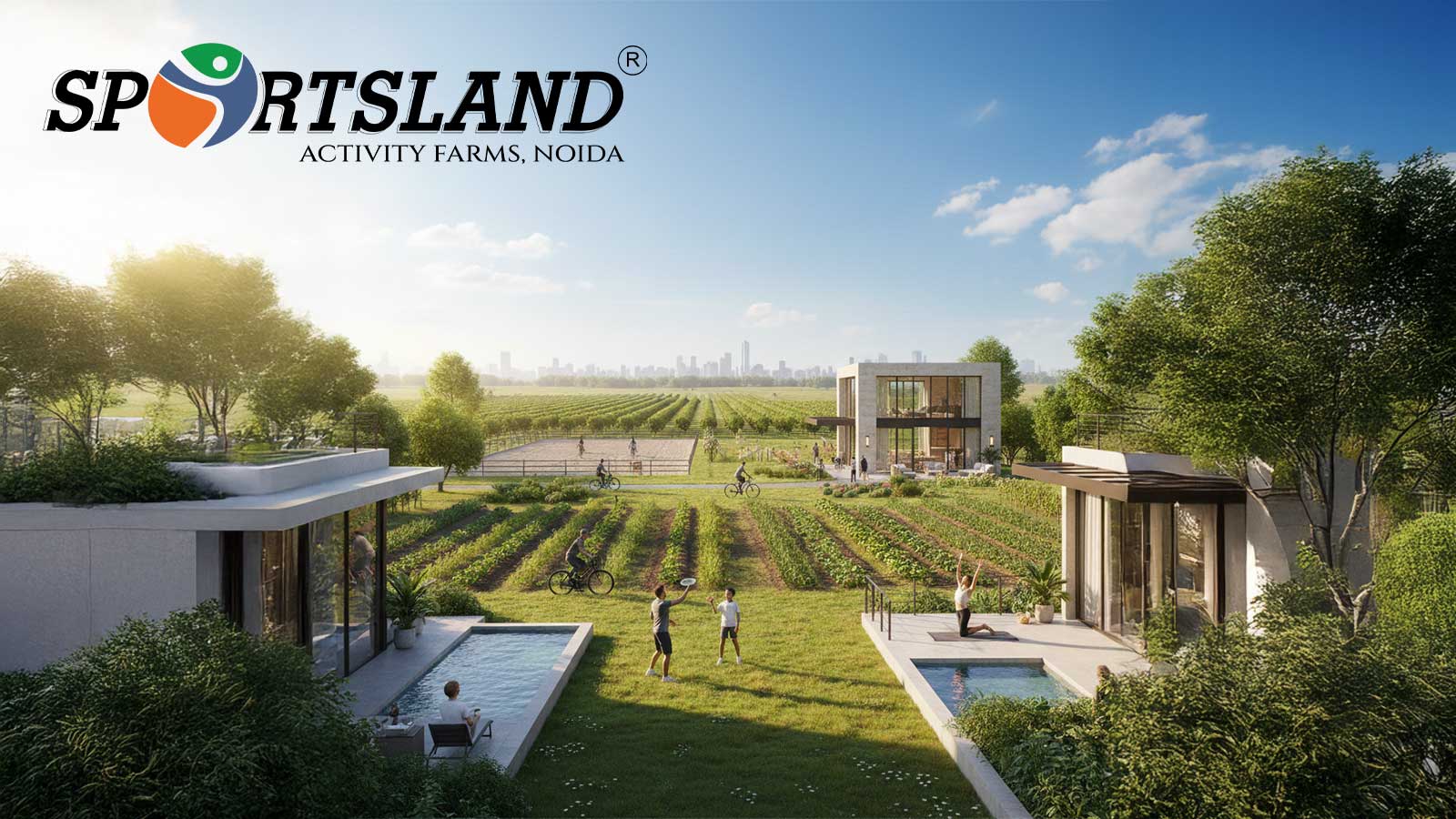
For those seeking such a lifestyle in a structured, well-planned setting, communities like Sportsland Activity Farms illustrate how land, sustainability, and human-centric design can come together to support meaningful living—today and for generations to come.
Not loudly.
Not urgently.
But deliberately.