Why Buy a Box in the Sky When You Can Own an Acre?
Stand on the balcony of a typical ₹2 crore Noida apartment.
Below you is a river of traffic. Above you is a thick, grey lid of smog. The AQI display on your phone quietly sits in the “Very Poor” or “Severe” zone. Your kids ask to go down and play, but within fifteen minutes they’re back upstairs complaining that their eyes burn and their throat hurts. Your parents cough through the night, and the air purifier has become the unofficial family member that never gets a break.
Now shift the frame.
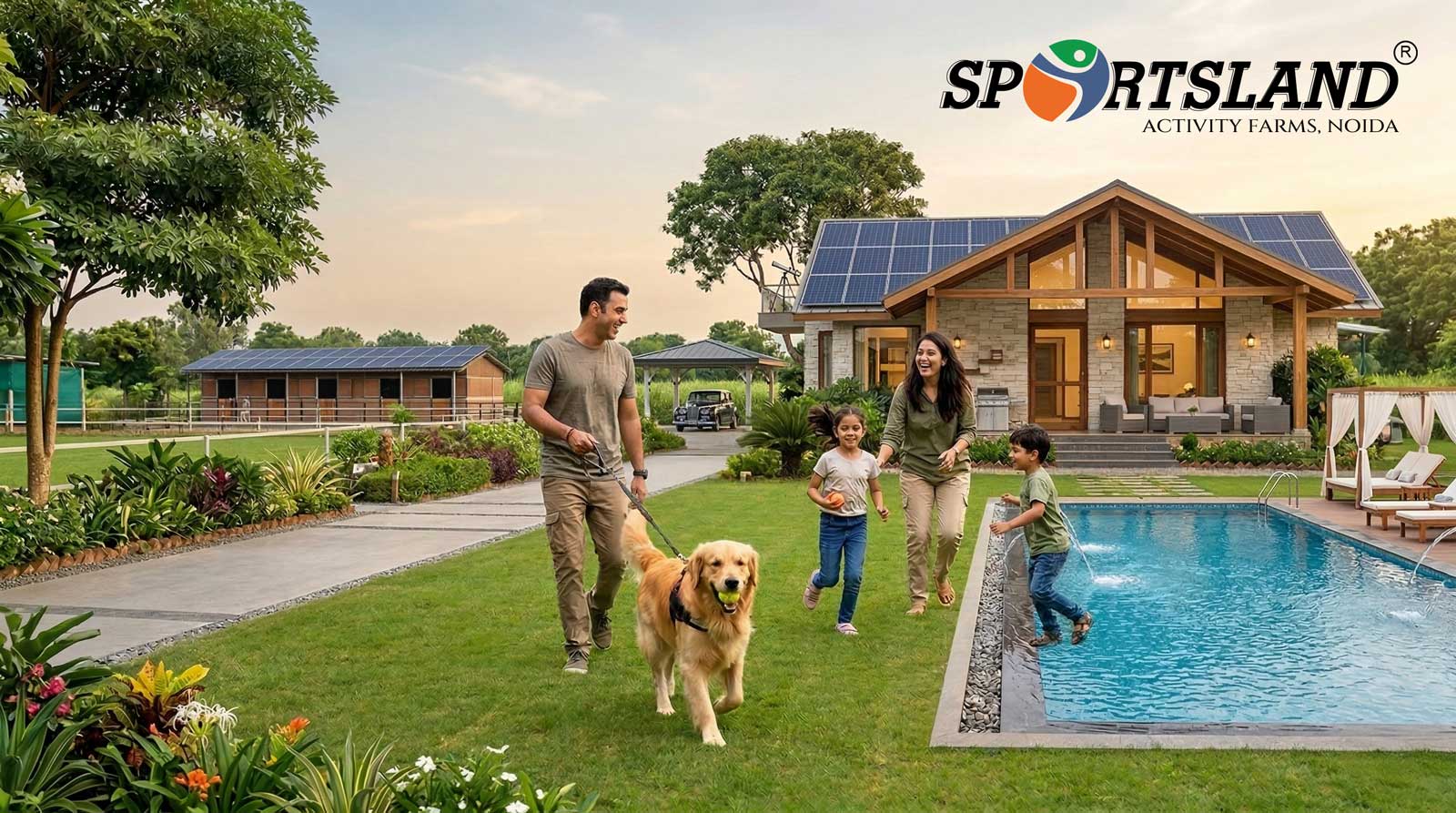
You wake up in a quiet green belt off the Noida Expressway. The first sound you hear is not a honk, but birds. There is grass under your feet, not tiles. Your kids are already outside—cycling, chasing butterflies, feeding ducks, or plucking guavas from the backyard trees. Your parents walk slowly along a tree-lined path, breathing deeply without a mask. You drink milk from your own cows, vegetables from your own kitchen garden, and sit under the shade of a neem tree to start your day.
And the cost of this life?
Roughly the same as that 3BHK you were about to book.
That’s the new reality of 2025: you can now own a farmhouse at the price of an apartment on the edge of Delhi-NCR. The old equation—flat = necessity, farmhouse = unreachable luxury—has flipped. Flats have become more expensive, more cramped, and more polluted, while planned farm communities have become accessible, better-designed, and in many cases healthier and safer for families.
This isn’t just a lifestyle choice. It’s a survival decision.
The World Health Organization calls air pollution one of the largest environmental health risks in the world, responsible for millions of premature deaths every year. Delhi, according to recent analyses, now records annual PM2.5 levels over 104 µg/m³, more than twice India’s own legal standard and over 20 times the updated WHO guideline.
Families are finally joining the dots:
If the cost is similar, why not choose a farmhouse at the price of an apartment and give your family land, air, animals, and freedom instead of a concrete box?
Delhi-NCR’s Air: From “Bad” to a Full-Blown Health Emergency
We’ve normalised the word “smog”. We talk about AQI like the weather. But the numbers are not normal; they are frightening.
What the Numbers Really Say
The Central Pollution Control Board (CPCB) runs a nationwide network of air-quality stations and publishes daily AQI data. Delhi’s AQI frequently sits in the “Very Poor” (301–400) and “Severe” (401–500) bands during winter, and neighbouring NCR cities like Noida, Ghaziabad, and Gurugram follow closely behind.
A 2024 analysis by the Centre for Science and Environment (CSE) pegged Delhi’s annual PM2.5 concentration at about 104.7 µg/m³, more than twice India’s National Ambient Air Quality Standard (40 µg/m³) and vastly above the WHO’s updated guideline of 5 µg/m³.
For context, the WHO estimates that 4.2 million deaths each year are linked to ambient outdoor air pollution alone—through heart disease, stroke, chronic obstructive pulmonary disease (COPD), lung cancer and acute respiratory infections.
2.2 Children and Grandparents Pay the Highest Price
Children breathe faster, their lungs are still developing, and they spend more time outdoors (or they should). Studies of Indian children have linked higher PM2.5 exposure with greater risks of respiratory infections, low birth weight and anaemia. At the same time, elderly people and those with existing heart or lung disease face higher risks of heart attacks, strokes and hospitalisation during polluted days.
Recently, over 80 Padma awardee doctors called India’s bad air a “direct health emergency”, warning that it contributes to around 1.7 million deaths each year and nearly 400,000 child deaths.
Put simply: staying in the thick of Delhi’s pollution long-term is not a neutral choice; it’s a health decision with a known, negative outcome.
That’s why the idea of moving slightly outwards—to cleaner, greener belts along the Noida Expressway, around Sector 151, in planned farm communities—now feels less like indulgence and more like insurance. And when you discover you can do it as a farmhouse at the price of an apartment, the equation becomes impossible to ignore.
The High-Rise Trap: Delays, Density and Disappointment
Pollution is only one half of the story. The other half is how broken the high-rise promise has become for thousands of Delhi-NCR families.
The Delayed Possession Epidemic
Over the last decade, NCR has developed a terrible reputation for delayed and stalled apartment projects. Several analyses and RERA-linked reports point to over three lakh delayed units across the region, with many projects stuck for years beyond their promised timelines.
For families, that means:
- Paying rent and EMIs simultaneously
- Watching savings evaporate while the promised lifestyle stays on paper
- Living with constant anxiety about whether the project will ever be completed
Even when the building is completed, the neighbourhood often remains a semi-construction zone for years, adding dust, noise and chaos to already polluted air.
Density Without Real Community
Most high-rise projects sell the dream of “community living” with clubhouses, gyms, and manicured lawns. In reality:
- Hundreds of families share limited common spaces
- Children are restricted to small play areas and must be supervised at all times
- Pets are regulated by constant society notices
- Privacy is minimal; balconies stare into other balconies
You pay premium prices for a 1,600–2,000 sq ft shell in the sky with very little real land attached to it.
Now compare that to owning actual earth—soil, trees, sky, and silence—via a farmhouse at the price of an apartment. It’s not hard to see why more and more NCR families are quietly walking away from the high-rise dream.

The Shocking Price Parallel: When a 3BHK Equals a Farm
Let’s talk numbers, because this is where the phrase farmhouse at the price of an apartment becomes literally true.
What a 3BHK in Noida Costs Today
Public property portals and market trackers show that as of 2024–25:
- Noida Sector 150: 3BHK flats often range between ₹1.8–2.25 crore
- Sector 128 (golf-course belt): ₹2.5–3+ crore
- Sector 93/93B: ₹1.7–2.4 crore
- Premium towers on the Expressway: ₹2–3.5 crore, depending on brand and size
So, a functional, mid-to-upper segment 3BHK in a half-decent project will comfortably sit around ₹1.8–2.5 crore.
What a Farmhouse Plot Costs Near Sector 151
On the other hand, in the peri-urban green belt around Noida Sector 151 and the Expressway, planned farmhouse communities typically offer:
- Plot sizes from 1008 sq yd (~907 sq m) to 1200 sq yd and above
- Ticket sizes starting around ₹1.3–1.5 crore and going up to ₹2.5–2.75 crore, depending on location, amenities and development model
That means a family that was mentally prepared to spend ₹2 crore on a flat can instead redirect that money into:
- A large, titled farmhouse plot
- Inside a gated, amenity-driven green community
- Just a short drive from Noida’s schools, malls, and offices
The discovery that you can genuinely get a farmhouse at the price of an apartment is the moment when many buyers re-open their spreadsheet and rethink their life plan.
Land vs Concrete: The Value Comparison
For roughly the same capital outlay, you are choosing between:
Aspect | 3BHK Flat | Farmhouse at the Price of an Apartment |
Built-up / usable area | ~1,600–2,000 sq ft | 10–20× that in open land + cottages |
Possession risk | High (delays, litigation) | Low (land possession is immediate) |
Air & noise | Traffic, dust, neighbours | Trees, fields, birds |
Lifestyle | Elevator, balcony, small play area | Backyard, orchard, pet zones, farming |
Appreciation | Slows after a point | Land historically appreciates faster |
Financially, emotionally, and environmentally, the farmhouse at the price of an apartment wins hands down.
What Science Says: Green Space Is Medicine
This shift towards farmland living isn’t just emotional nostalgia. A growing body of international research shows that green spaces work like a natural medicine cabinet for our bodies and minds.
Greenery and Mental Health
A large systematic review and meta-analysis published in Environmental Research found that people with better access to green spaces have significantly lower risks of depression and anxiety, alongside improved perceived well-being.
When kids grow up with trees, soil, and open skies, they are not just “happier”; they are neurologically better wired for resilience and emotional balance.
Green Space and Lifestyle Diseases
Another meta-analysis of longitudinal studies on green space exposure and cardiometabolic risk found that higher access to greenery was associated with:
- 19% lower odds of hypertension
- 17% lower odds of obesity
- 21% lower odds of diabetes
In a country where lifestyle diseases are climbing rapidly, this is no small advantage.
Trees vs PM2.5
Urban ecology research shows that trees and vegetation help:
- Capture particulate matter (including PM2.5) on leaves and bark
- Break wind patterns that trap dirty air
- Reduce surface and air temperatures, which in turn reduce ozone formation
Delhi-specific analyses have documented how areas with denser vegetation exhibit somewhat lower pollutant concentrations compared to bare concrete zones.
Living in a green, low-density farmhouse community won’t magically teleport you to the Swiss Alps—you’re still in the NCR airshed—but it does significantly cut your family’s daily exposure compared to a balcony hanging over a major arterial road.
That’s one more reason buyers are gravitating toward a farmhouse at the price of an apartment—the science is finally on the side of nature.
Children, Grandparents, and Pets: The Three Big Winners
Children: From Screen Time to Sunshine
The WHO’s guidelines on physical activity for children emphasise daily moderate-to-vigorous movement and outdoor playtime for healthy physical and cognitive development.
In a high-rise:
- Playtime depends on lifts, schedules, and pollution levels
- Outdoor hours shrink, screen hours explode
- Natural exploration is limited to one tyre swing and a slide
In a farmhouse community:
- The “play area” is the entire landscape
- Kids climb trees, plant saplings, chase butterflies, ride bicycles, splash in mud
- They learn real-world skills: farming, caring for animals, understanding seasons
Parents who choose a farmhouse at the price of an apartment often describe it as “buying childhood back” for their kids.
Grandparents: Walking Into Better Health
Seniors forced to live indoors for most of the year suffer from loneliness, stiffness, anxiety, and a higher risk of cardiovascular events. Green surroundings, on the other hand, have been linked to lower all-cause mortality and better heart health in several large cohort studies.
A farmhouse community gives them:
- Space for slow walks and yoga
- Sunlight and fresh air
- A sense of purpose—gardening, feeding animals, supervising kids in the fields
Pets: No More “Society Rules”
Anyone who has tried keeping a dog in a high-rise knows the drill: constant fights over lifts, lawns, poop, barking, and “pet-free zones”.
In a well-planned farmhouse ecosystem, pets are not a problem to be managed, they are part of the lifestyle:
- Dogs can actually run
- Cats can roam
- Ducks, chickens, rabbits, cows, turtles—each has space
When you choose a farmhouse at the price of an apartment, you’re also choosing a home where every family member, two-legged or four-legged, actually belongs.
Location Logic: Why the Noida Expressway Farm Belt Works
Sceptical readers might ask: “Isn’t this all too far from the city?”
The answer, at least for the Noida Expressway–Sector 151 belt, is no.
- The Expressway links directly to major Noida and Delhi hubs
- Schools, universities, hospitals, and malls sit within a manageable drive
- Planned infrastructure around the Yamuna Expressway and upcoming nodes keeps connectivity future-proof
- You work in the city’s bustle by day and retreat to green silence by evening
In other words, you get the weekend-home vibe every day, without giving up your job or your kids’ education.
That is precisely why the idea of a farmhouse at the price of an apartment is exploding in this corridor: you don’t have to choose between isolation and opportunity—you get both nature and access.
Investment Brains: Why Land Still Wins
Even if you strip away the emotional and health lenses, the maths still favours land.
- Flats depreciate physically (paint, plumbing, common areas) even as land values appreciate—net gain slows with time.
- Land-backed assets like farm plots tend to hold and grow value more steadily, especially when they’re part of a branded, amenity-rich community.
- You can build flexibly: a cosy cottage now, a larger home later, or multiple units for rentals and family.
- Farmhouses near major metros are gaining traction as weekend rentals and experiential stays, opening new income streams.
So if you can park the same capital into a flat or a farmhouse at the price of an apartment, the latter is increasingly seen as the smarter legacy asset.
“But Are Farmhouses Legal?” — Clearing the Biggest Doubt
The question is valid. Over the years, NCR has seen many unregulated “farmhouse” developments.
The key difference today is in planned, policy-aligned, community-style farm projects, where:
- Land titles are clear and documented
- Land-use norms and plotting are aligned with local regulations
- Internal infrastructure (roads, drainage, water, power) is planned
- There is clear demarcation, security, and community rules
When you choose a professionally developed farmhouse at the price of an apartment in such a layout, you’re not gambling—it’s closer to buying into a plotted township, but with trees instead of towers.
As always, due diligence is essential: check approvals, cross-verify land records, and, where applicable, look for RERA registration or equivalent regulatory oversight.
FAQ
1. Is it really possible to buy a farmhouse at the price of an apartment in Noida?
Yes — and this is one of the biggest shifts in Delhi-NCR real estate today.
A mid to premium 3BHK apartment in Noida sectors 150, 93, 128, or the Expressway belt typically costs ₹1.8 to ₹2.5 crore.
Meanwhile, planned farmhouse communities near Sector 151, Noida Expressway, and Yamuna Expressway offer 1000–1200 sq yd plots for ₹1.35 to ₹2.75 crore depending on amenities, infrastructure, and brand value.
This means you can genuinely own a farmhouse at the price of an apartment, gaining 10–20× more land area with healthier air, lower density, private greens, and a high-quality lifestyle.
2. Are farmhouses legal? What approvals should I check before investing?
Yes — farmhouses are legal when purchased within planned, policy-compliant communities.
Before investing, ensure the project has:
- ✔ Clear land titles (khasra, khatauni)
- ✔ Zoning aligned with agricultural/residential permissible use
- ✔ Road access as per district authority guidelines
- ✔ Plot demarcation certificates
- ✔ Registry and mutation history
- ✔ Any applicable RERA registration (varies by plotting model)
Avoid unregulated standalone farms. Choose communities developed under clear frameworks to ensure safety, resale value, and future build rights.
3. Are farmhouses safe for families with children and elderly people?
Absolutely. In fact, they’re healthier and safer for vulnerable age groups.
Children benefit from:
- Fresh air
- Outdoor play
- Open cycling and running areas
- Pets and nature exposure
- Lower screen dependency
Elderly family members enjoy:
- Lower stress and blood pressure
- Cleaner breathing environment
- Peaceful surroundings
- Walk-friendly landscapes
Studies show green exposure significantly improves mental well-being, reduces anxiety, improves the respiratory system, and enhances cardiovascular health.
4. Will I still get city-level connectivity while living in a farmhouse?
Yes.
Most Noida farm communities around Sector 151 are designed to offer:
- 10–12 minutes from Noida Expressway
- 15–20 minutes to Schools, Malls, IT Parks
- 20–25 minutes to Sector 18
- Airport access via Jewar Airport Corridor (upcoming)
- Multiple arterial roads for smooth mobility
You get countryside calm without compromising city access.
5. How does living in a farmhouse improve air quality and health?
Living in a farmhouse exposes you to a tree-dense, low-traffic microclimate, which naturally reduces your family’s daily pollution exposure.
Benefits include:
- Lower PM2.5 intake
- Less heat (natural cooling by shade)
- Reduced dust due to vegetation
- Cleaner airflow
- Fresh oxygen from large green cover
Delhi-NCR’s high-rise clusters trap pollution between buildings. Farmhouses, on the other hand, spread out homes across vast land, reducing airborne contamination and improving daily breathing quality.
6. Is a farmhouse a better investment than a high-rise apartment?
In most cases — yes.
Why farmhouses often outperform flats long-term:
- Land is a non-depreciating asset
- Limited supply → higher demand among HNIs/NRIs
- Farm communities grow in value as cities expand
- Rental potential through weekend stays
- Lower maintenance compared to towers
- No construction-linked delays
High-rise apartments lose value due to construction ageing, society wear and tear, and overcrowding. Farmland-based assets appreciate steadily thanks to growing lifestyle demand + scarcity factor.
7. What lifestyle differences should I expect between an apartment and a farmhouse?
The difference is transformational.
Apartment life includes:
- Shared spaces
- Congestion
- Pollution from roads
- High maintenance fees
- Indoor, screen-heavy childhoods
- Noise and restrictions
Farmhouse life offers:
- Open land
- Private backyard
- Organic farming
- Pet-friendly living
- Cleaner microclimate
- Outdoor growth for kids
- Family bonding with nature
- Peace, privacy, and silence
Many families describe it as “shifting from survival to actual living.”
8. Will maintenance be difficult in a farmhouse community?
Not in a well-managed farmhouse township.
Modern farm communities offer:
- Security
- Internal roads
- Gardening teams
- Utility maintenance
- Waste management
- Water and electricity provisions
The goal is to provide the benefits of nature with the convenience of managed living—without the overcrowding of tower societies.
9. Can I build a home on my farmhouse plot?
Yes.
Most planned farmhouse communities allow you to construct:
- A cottage
- A weekend retreat
- A 2–3 floor home
- A villa
- Or a hybrid structure with farming + living areas
Construction is typically customizable, giving you creative freedom while adhering to basic guidelines like:
- Setback rules
- Maximum permissible height
- Eco-friendly practices
Unlike flats, here you decide the design, size, and purpose.
10. Why are families shifting to farmhouse communities instead of buying luxury apartments?
Three major reasons:
1. Health
Delhi’s PM2.5 crisis has become severe. Families want natural, safe breathing zones—especially for kids and grandparents.
2. Space
Apartments offer 1,800 sq ft. Farmhouses give 1 acre or more — with nature as your playground.
3. Value
A farmhouse at the price of an apartment provides:
- More land
- More freedom
- More lifestyle quality
- Better environmental health
- Stronger long-term value
It’s a once-unthinkable upgrade that more NCR families are embracing because it simply makes sense.
The Real Question Isn’t “Can I?” It’s “How Long Can I Wait?”
Here’s the quiet truth that many families in Delhi-NCR already feel in their bones:
- The air is not going to fix itself overnight.
- High-rise delays are not going to miraculously disappear.
- Children only get one childhood; grandparents only get so many healthy years.
If the cost difference was huge, you could argue that a farmhouse is a dream for “someday”. But when you can genuinely buy a farmhouse at the price of an apartment, someday turns into now.
You’re not just swapping walls for trees. You’re trading:
- Stress for stillness
- Screens for soil
- Filters for forests
- Concrete maintenance bills for land that nourishes and appreciates
In the end, this isn’t a blog about real estate. It’s a blog about what kind of life you want your family to live.
If a 3BHK in the sky and a one-acre green world cost roughly the same, ask yourself one simple, radical question:
Do I want to spend the next decade fighting for possession and pure air in a tower, or do I want to move my family into a farmhouse at the price of an apartment and start living the life we keep saying we’ll live “one day”?
The market has quietly shifted. The numbers have already changed.
The only thing left to change is your decision.