Organic Farming Community in Noida → Your Clean-Eating Escape from Pesticide-Laden City Veggies
You walk into a local market in Delhi-NCR, pick up a basket of fresh vegetables, and marvel at the vibrant colours. But beneath that vibrancy, something trouble-brews: invisible chemical residues lurking on the produce you place on your family’s plate. What if I told you that your child might be eating vegetables sprayed with dozens of different pesticides? And what if the real escape isn’t further down the supply chain but closer to home — in a fully functioning organic farming community in Noida, where your food is grown, harvested, and served to you with minimal chemical interference?
This blog dives deep: we’ll examine hard Indian government data, dig into local studies around Delhi-NCR, and uncover how a true organic farming community in Noida offers a credible solution — not just another “healthy food” gimmick. By the end you’ll understand the magnitude of the risk, why the solution matters now, and how choosing the right community might be as important as choosing the right home.
1. The Invisible Risk: Pesticide Residues in Urban Produce
Why Delhi-NCR is uniquely exposed
The region around Delhi — including Noida, Greater Noida and the urban fringe — is a high-stress agricultural zone. Rapid urban expansion, intense peri-urban farming, heavy cropping intensity and short harvest cycles all conspire to increase pesticide application. When you pair that with weak oversight of residue disposal, you get a recipe for contamination.
One landmark study sampled vegetables in and around Delhi and found this: “all the vegetable samples were contaminated with pesticides, but 31% of the samples contained pesticides above the prescribed tolerance limit.” That means nearly one of every three vegetables you buy in the city may be breaching legal limits.
For the layperson, that’s a red flag. Intuition often says “fresh local veggie = safer” — but that study undercuts it.
Nation-wide surveillance & the official story
At the national level the government runs the central sector scheme Monitoring of Pesticide Residues at National Level (MPRNL) (since 2005-06) to test pesticide residues in food, soil and water. According to one official FSSAI-linked report, among 4,510 samples collected in 2017-18, pesticide residues were detected in 19.1% of all samples and only 2.2% exceeded maximum residue limits (MRLs).
So: the national data suggest a relatively low proportion of samples breach legal limits; the local Delhi-NCR data suggest a far higher risk (31%).
The health implications: why you should care
Why does this matter? Because exposure to pesticide residues is not benign. Recent research flagged for India suggests multi-class pesticide residue exposure may contribute to long-term health risks such as neurological disorders, endocrine disruption, reproductive issues, even some cancers. Kids are especially vulnerable: lower body weight, developing organs, more ingestion relative to size. And when you’re living in the Delhi-NCR smog + pollution belt, the “food risk” becomes one more layer.
The consumer reality: scepticism & willingness to pay
A survey of vegetable consumers in Delhi revealed more than two-thirds believed fresh vegetables contain pesticide residues, and close to 80 % felt the residues would have serious health implications. Moreover, about 85 % of those respondents said they’re willing to pay more for “residue-safe” vegetables. That’s a clear signal: the market wants clean-eating options. If you’re building a product or community around that need, you’ve hit a real demand.
Why Conventional Farming Around Noida Falls Short
Intensive cropping + short-cycle harvests
In a peri-urban region like Noida, agriculture is under pressure: multiple cropping seasons, short growth durations, high turnover, and a tilt toward commercially attractive but high-input crops (vegetables, leafy greens, quick-harvest crops). These factors push farmers toward heavier pesticide use and shorter withdrawal periods before harvest — meaning higher residue risk.
Supply chain, distance & handling issues
Even if the farmer uses pesticides responsibly, the supply chain in Delhi-NCR often involves multiple hands, transport in non-ideal conditions, and extended storage. Each link introduces risk: chemicals can degrade into harmful by-products; new contamination may occur. Urban vendors aren’t always fully trained in safe food handling, and monitoring is weak.
Why “local produce = safe” is not guaranteed
The intuition that “fresh from the region = safe” gets challenged by the Delhi-NCR data: despite proximity, contamination is high. When you buy vegetables from market stalls in Noida or Delhi, you may be buying produce grown just outside the city — but those farms likely used high-input methods and are subject to the same residue issues.
The Solution: Living in an Organic Farming Community in Noida
What does “organic farming community in Noida” mean?
Here we’re not just talking about a gated housing colony with a “community garden”. We mean a full-scale residential township in the Noida region where:
Every family has access to private or shared organic farmland on site or nearby.
Farming practices follow strict non-chemical or minimal-chemical standards: certified organic, no synthetic pesticide or very restricted, natural pest management.
Supply chain is internalised: residents eat produce grown within the community, limiting external contamination risk.
Education, composting, rain-water harvesting, soil regeneration, crop rotation, organic manures are part of the lifestyle.
If this is built right, the focus keyword “organic farming community in Noida” becomes not just a phrase, but a lifestyle proposition.
Why this model addresses the problems above
Reduced external chain risk: Fewer hands, fewer transport steps = lower risk of contamination or harmful handling.
Controlled inputs: Since the community sets standards, pesticide usage is minimal and monitored. Residents know where the food comes from.
Transparency + accountability: When you live within the system, you see what’s happening. That builds trust.
Lifestyle alignment: Many affluent families in Delhi-NCR want healthier, greener living. An organic farming community in Noida meets that demand for wellness, clean-air, nature, pet-friendly space, and safer food.
Why Noida is a smart choice for such a community
Proximity to Delhi: easy access for professionals.
Growing demand: families seeking cleaner, greener weekend homes or relocation bases.
Peri-urban scale: enough land for farming plots, yet close enough for urban amenities.
Contextual relevance: The region is exposed to high food-chain and air-pollution risks — so the value of escape is stronger.

The Proof That It Works — Data & Case Studies
Indian monitoring data (backing the risk)
- The MPRNL scheme under the Food Safety and Standards Authority of India (FSSAI) shows in 2017-18, 2.2% of all samples tested exceeded MRLs.
- A recent Haryana study (2025) of 161 pesticides across 102 vegetables, 46 soil and 50 water samples found pesticide residues in 30.39% of vegetable samples, 95.65% of soil samples and 68.0% of water samples.
- The Delhi study: all vegetable samples contaminated, 31% above tolerance levels.
These show the risk is real and measurable.
Consumer demand data (backing the opportunity)
- In Delhi: More than two-thirds of consumers believed fresh vegetables contain pesticide residues; ~85% willing to pay more for residue-safe produce.
Regulatory context & system limitations
- Pesticide regulation: India’s pesticide registration process has issues. A 2022 PAN-India report shows many “deemed to be registered pesticides (DRPs)” — hundreds of agrochemicals that entered the market before full safety evaluation.
- Editorial analysis: monitoring pesticide residues in food is still a “major challenge” for India’s food safety system.
When regulation is imperfect and monitoring is patchy, the “safe” assumption becomes weaker — reinforcing the value of controlled environments like an organic farming community in Noida.
Why the community model carries higher credibility
When you live in a controlled organic farming community in Noida:
- The food you consume is grown locally, not trucked in from far-away zones.
- Farming practices can be audited and shown.
- Residents can see the soil, the composting, the water harvesting, the absence of heavy chemical sprays.
- The community can brand itself around “pesticide-safe produce grown on-site” and match the consumer willingness to pay more for residue-safe food.
In plain terms: you’re selling peace of mind as much as you’re selling a plot of land.
How to Assess an Organic Farming Community in Noida Before You Commit
Here’s your checklist for forward-looking families:
- Plot design and size
- Does every home/resident get a farm plot or is it shared?
- Are farm plots in the same township or detached?
- How big are the plots — enough to grow meaningful produce for a family?
- Does every home/resident get a farm plot or is it shared?
- Organic certification / standards
- Does the community follow certified organic protocols (or at least adopt equivalent standards)?
- Are synthetic pesticides avoided? Are only low-toxicity, approved inputs used?
- Is there transparency (spray logs, audits, resident access)?
- Does the community follow certified organic protocols (or at least adopt equivalent standards)?
- Supply chain & internal consumption
- Can residents consume what they grow (harvest-to-table)?
- Are there farmer-led plots, community composting, rain-water harvesting, vermi-composting and on-site farm-to-table arrangements?
- Is produce sold externally, or kept internal for resident consumption?
- Can residents consume what they grow (harvest-to-table)?
- Location, accessibility & lifestyle
- How far is the site from Noida/Delhi urban hub?
- Connectivity, schools, malls, hospitals — does the township meet the live-work-play requirements?
- What are the surrounding land use / zoning factors (industrial belts, bypasses, expressways, green belts)?
- How far is the site from Noida/Delhi urban hub?
- Soil & environmental baseline
- Has soil been independently tested? What are the residue levels?
- Is the site in a “clean air / low pollution” zone? Because for families buying such a lifestyle, total environment matters (air quality, open green space, safe water).
- Has soil been independently tested? What are the residue levels?
- Community health & wellness features
- Is the community designed for children, pets, green open space, low-traffic zones?
- Are there wellness amenities (walking trails, organic café, kids’ farm-learning zones)?
- Is the community designed for children, pets, green open space, low-traffic zones?
- Exit / value appreciation metrics
- Given growing demand for wellness and clean-living in Delhi-NCR, what’s the likely appreciation of such a community?
- How many other comparable options exist — is this unique?
- Given growing demand for wellness and clean-living in Delhi-NCR, what’s the likely appreciation of such a community?
If the community ticks most of these boxes, you’re looking at not just a home — but a lifestyle investment in the “organic farming community in Noida” niche.
FAQs
1. What exactly is an organic farming community in Noida?
An organic farming community in Noida is a residential township designed around sustainable food production. Unlike regular gated complexes, these communities allocate dedicated organic farm plots to residents, maintain pesticide-free farming standards, use natural composting systems, and grow vegetables within the township. It is a lifestyle ecosystem that combines clean eating, wellness living, and green open spaces — especially appealing to Delhi-NCR families worried about air quality, food safety, and urban stress.
2. Is organic farming really safer than conventional produce?
Yes — when done correctly. Organic farming prohibits the use of synthetic pesticides, heavy chemicals, and toxic soil treatments. Studies from Delhi-NCR show 31% of vegetables tested contained pesticide residues above legal limits, while an Indian national monitoring scheme found nearly 20% of samples carried detectable residues. By living inside an organic farming community in Noida, families reduce their exposure significantly because the produce comes directly from monitored, chemical-free internal farms.
3. How do I verify if a community is genuinely organic and not just marketing it?
Ask for:
- Soil test reports
- Water quality tests
- Full spray logs
- Composting facility details
- Crop rotation and natural pest-control methods
- External audits or certification (PGS-India / NPOP)
- Transparency in seasonal yield reports
4. Does buying a home in an organic farming community increase property value?
Yes. Wellness-driven real estate is one of the fastest-growing luxury segments in India. As Delhi-NCR families prioritise clean air, green zones, and healthy living, the demand for such communities continues to rise. An organic farming community in Noida benefits from:
- Scarcity of similar developments
- Strong buyer sentiment for clean-living ecosystems
- Long-term sustainability appeal
- Higher rental demand for wellness-oriented homes
This makes it both a lifestyle and appreciation-driven investment.
5. Can residents actually grow enough vegetables for their family inside these communities?
Most well-designed communities provide 500–2,500 sq ft plots which, with organic farming, can yield enough leafy greens, herbs, seasonal vegetables, and basic staples for a family of 4–6. It may not replace 100% of your food basket, but it significantly reduces market dependency. Plus, residents can participate in supervised farming where experts handle the labour while you enjoy the benefits.
6. Is living in an organic farming community in Noida suitable for children and older adults?
Absolutely. These communities are designed around:
- Cleaner air
- Pollution-free green cover
- Safe play zones
- Organic food
- Pet-friendly paths
- Calm, low-noise environments
- Wellness amenities like walking tracks, meditation zones, nature trails
For children, it creates a grounded, nature-connected childhood. For older adults, it improves mental well-being, respiratory health, and mobility.
7. How much maintenance does organic farming require from residents?
Most communities follow a “managed farming” model, where agricultural experts handle daily tasks like irrigation, composting, sowing, pest control, and harvesting. Residents simply enjoy the produce. If you want, you can participate hands-on — but it is not mandatory. This hybrid model makes an organic farming community in Noida ideal even for busy working families.
8. Are organic farming communities more expensive than regular projects?
They can be slightly premium due to:
- Larger land parcels
- Green zones and farming areas
- Low-density layouts
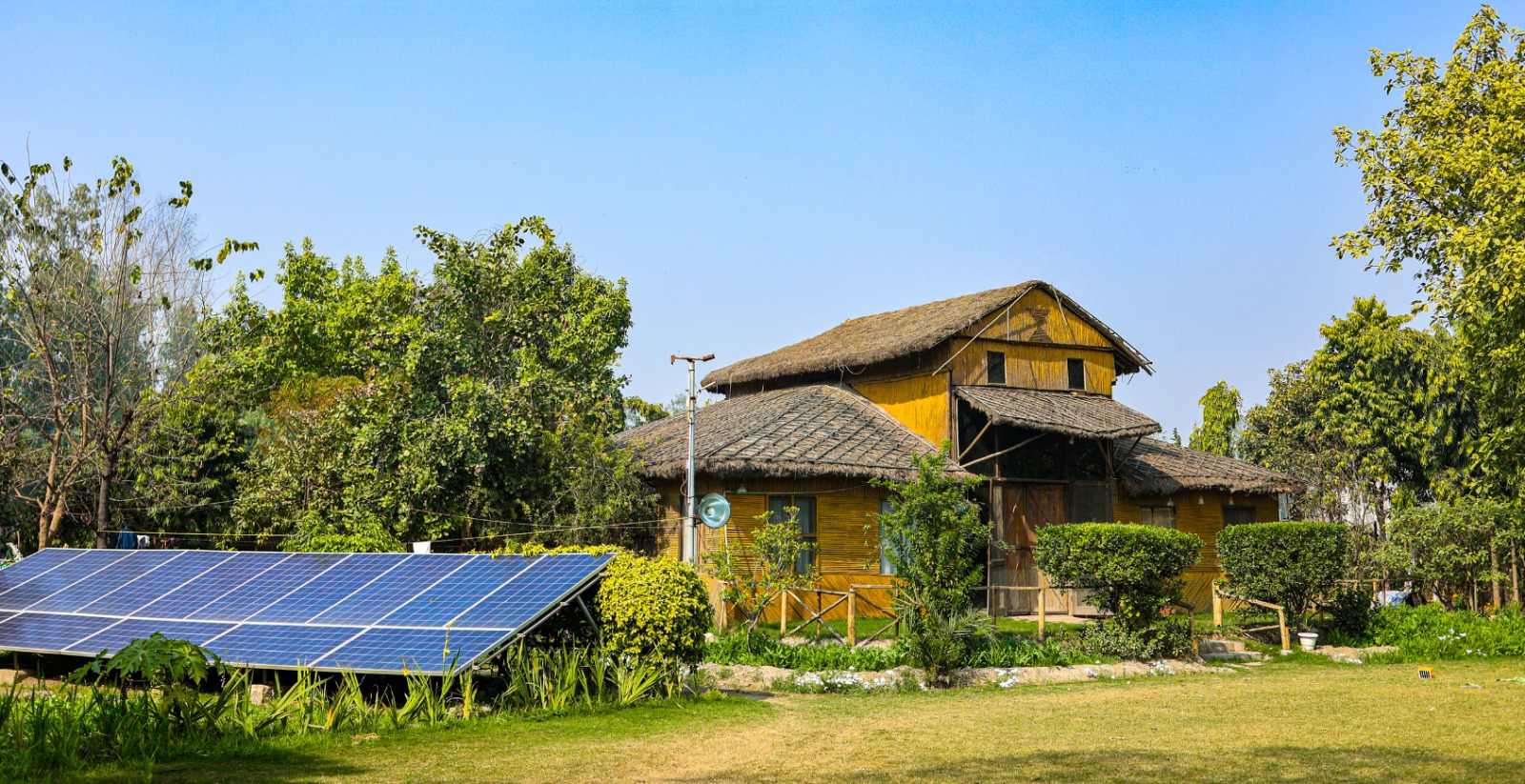
- Sustainability infrastructure (rainwater harvesting, composting, solar provisions)
- Farm-to-table facilities
However, the value delivered — safe food, wellness lifestyle, cleaner environment, future appreciation — often outweighs the cost difference. Many buyers see it as a health investment rather than a real estate expense.
9. Do organic farming communities help reduce pollution exposure?
Yes — indirectly and directly.
Directly: These communities are built in greener, low-density pockets around Noida where air quality is significantly better than central Delhi.
Indirectly: Growing your own food reduces reliance on long-distance trucking, refrigeration, and cold-storage cycles — all of which contribute to pollution.
So, living in an organic farming community in Noida improves environmental impact and personal exposure.
10. Who should consider investing in an organic farming community in Noida?
This lifestyle is ideal for:
- Parents wanting chemical-free food for children
- Health-conscious individuals and fitness-focused families
- Working professionals looking for cleaner living
- Pet-owners seeking open green space
- NRIs wanting a sustainable investment
- Anyone tired of pollution-heavy urban lifestyles
- Wellness-focused retirees
- Investors looking for high-growth niche properties
If clean air, safe food, and peaceful living matter, an organic farming community in Noida is an excellent fit.
A true organic farming community in Noida will openly share these without hesitation. If the project refuses documentation, consider it a red flag.
If you’re feeding two or three generations (kids, parents, maybe pets) in Delhi-NCR, the tiny “residue risk” is anything but tiny. Pesticide residues are measurable, local research backs this, consumer demand for safe food is real — and yet most of us are still trusting fragmented supply chains.
What stands out is this: you don’t always need to shift geographies, you can shift model. An organic farming community in Noida gives you proximity, a controllable food chain, fresh air, wellness, open space. It’s less “weekend home” and more “whole-family base.” It’s less “buy land and hope for appreciation” and more “buy lifestyle, buy safety, buy food autonomy.”
If you’d like, I can pull up 3-5 current organic farming communities in Noida (with plot sizes, pricing, expected yields, resident testimonials) and compare which ones truly deliver on the “organic farming community in Noida” promise (vs. those that just label themselves.
Ready to explore your options? Let’s dig into the actual communities, visit videos, compare floor-plans and spot the one that aligns with your family’s values and long-term needs. Drop me a time and I’ll prepare a short-list of the best-fit ones this week.